You have a skincare brand concept, a target audience, and maybe even a visual identity — but no product yet. You start researching manufacturers and see "private label skincare" mentioned everywhere. Is it the same as OEM? Is it just slapping your logo on someone else's product? And most importantly: is private label the right manufacturing model for your brand?
Private label skincare is a product launch model where you sell skincare products under your own brand name using formulas and production systems provided by a manufacturer. The manufacturer handles formula development, raw material sourcing, production, quality control, and often packaging — you control branding, product selection, and market positioning. The real decision is determining how much customization, differentiation, and supply flexibility your brand requires at this stage.
Let me walk you through what private label actually means in practice, how it differs from other manufacturing models, and what decisions you'll face when launching your skincare line. I've worked with hundreds of beauty brands through this process, and most of the confusion comes from mismatched expectations around cost, timeline, customization, and what "private label" really includes.
What exactly does private label skincare mean?
Private label skincare sounds simple — you choose products, add your branding, and launch. But in practice, it sits at the intersection of several business decisions: how much product control do you need, how quickly do you want to launch, what level of differentiation matters for your positioning, and how much capital can you allocate to inventory?
Private label skincare means launching products under your brand using manufacturer-supported formulas, production capacity, and supply infrastructure. You select from existing or slightly customized formulas, control packaging and branding decisions, and sell the finished products as your own. The manufacturer handles formulation knowledge, raw material procurement, production systems, and quality management.
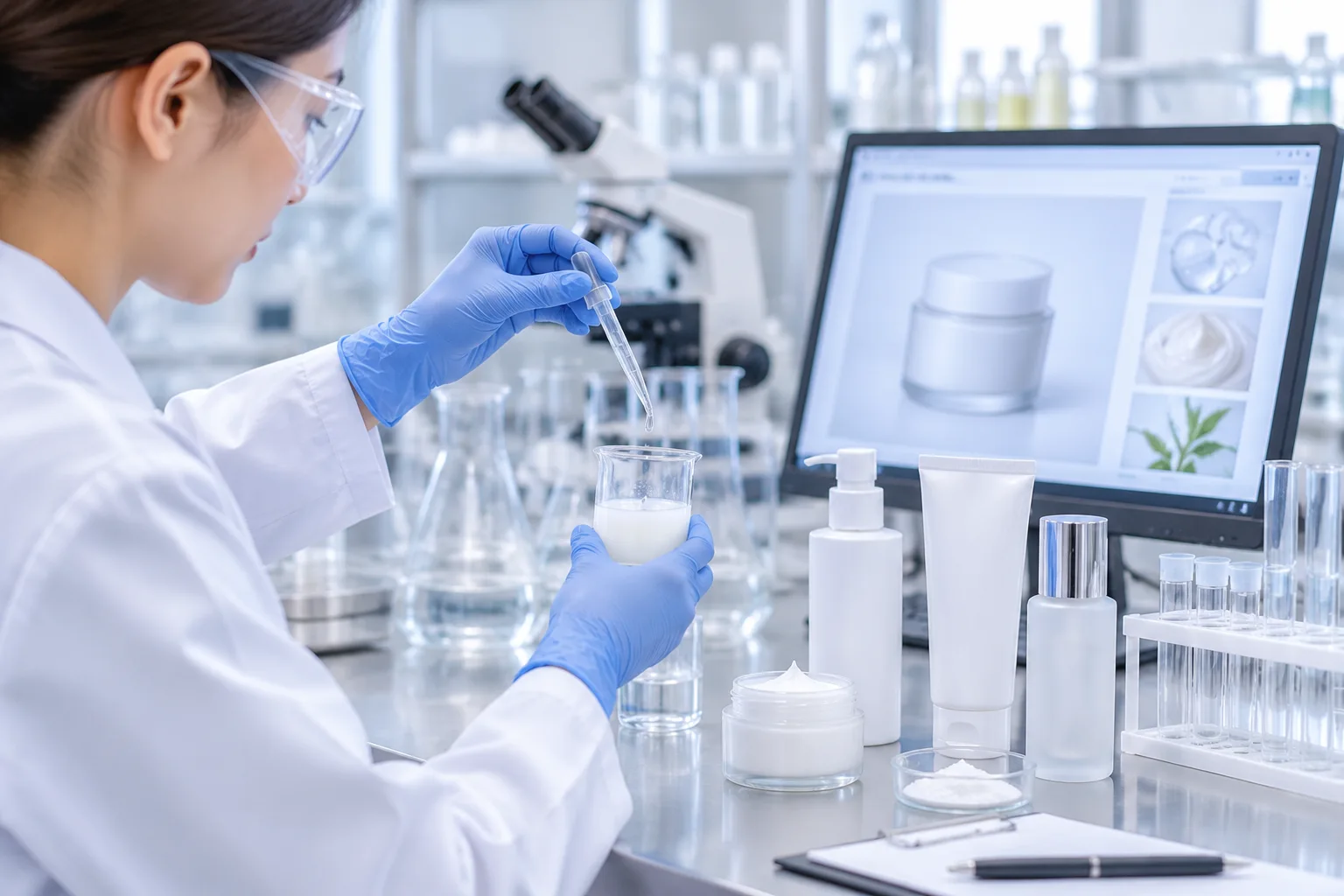
When I talk with new beauty brands, many assume private label means choosing a generic product and printing their logo on it. That misses the real value — and the real complexity. Private label is a spectrum. On one end, you have fully ready-made products with minimal customization. On the other, you have semi-custom formulations, texture adjustments, fragrance direction, active ingredient modifications, and completely custom packaging.
Your position on that spectrum determines your cost structure, minimum order quantities, lead times, and competitive differentiation. A facial cleanser with your logo on standard packaging might have a 500-unit MOQ and ship in 30 days. A facial serum with adjusted peptide content, custom fragrance, and unique bottle design might require 3,000 units and 90 days.
How private label fits into your product launch timeline
Most brands choose private label because of speed. Compared to developing a formula from scratch, testing stability, sourcing raw materials independently, and building production relationships, private label cuts months from your timeline. The manufacturer already has proven formulas, supplier relationships, production systems, and quality documentation.
But speed depends on how much you customize. If you select a proven formula with existing packaging, you can move from inquiry to samples in two weeks. If you want formula adjustments, custom fragrance, specialized packaging, and full testing documentation, expect 60–90 days before mass production starts.
I worked with a U.S. startup last year that wanted to launch "quickly" with private label. They selected a vitamin C serum, then spent six weeks deciding between three texture variations, four fragrance directions, and five packaging options. They weren't wrong to care about those details — differentiation matters — but their initial timeline assumption of "30 days to launch" didn't account for decision-making cycles and sampling rounds.
What private label includes (and doesn't include)
Private label from a manufacturing perspective typically includes:
- Access to existing formulas across skincare categories
- Formula modifications within established ranges (texture, fragrance, certain active adjustments)
- Raw material sourcing and inventory management
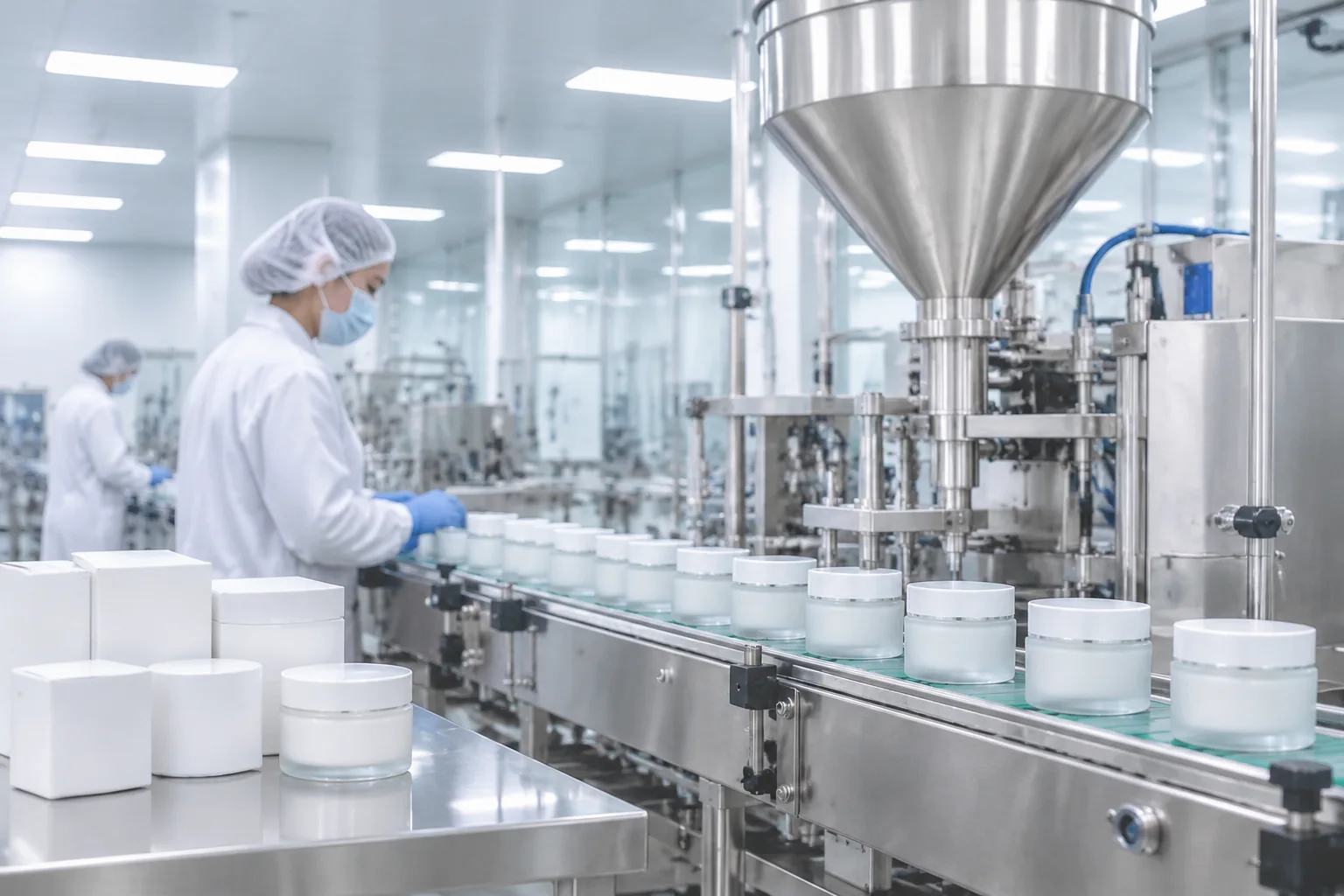
- Production, filling, and quality control
- Basic compliance documentation (COA, MSDS where applicable)
- Standard packaging options and customization support
Private label usually does not include:
- Full custom formula development from zero
- Market-specific regulatory approval (you handle compliance research for your target market)
- Marketing content, photography, or e-commerce setup
- Inventory financing or fulfillment warehousing
- Exclusivity over formula or packaging (unless negotiated)
The line between "included" and "not included" varies by manufacturer. Some offer turnkey packaging sourcing and graphic design support. Others provide formulas and production only. Clarify what's in scope before you assume.
How is private label different from OEM, ODM, and custom formulation?
This is where most confusion starts. Brands use "private label," "OEM," "ODM," and "custom formulation" interchangeably — but they represent different manufacturing models with different cost structures, lead times, MOQs, and outcomes.
Private label typically refers to selecting from a manufacturer's existing product catalog with flexible branding and packaging. OEM means manufacturing products according to your provided formula and specifications. ODM means the manufacturer develops the product concept and you brand it. Custom formulation means creating a unique formula specifically for your brand. Each model offers different trade-offs between speed, cost, differentiation, and control.
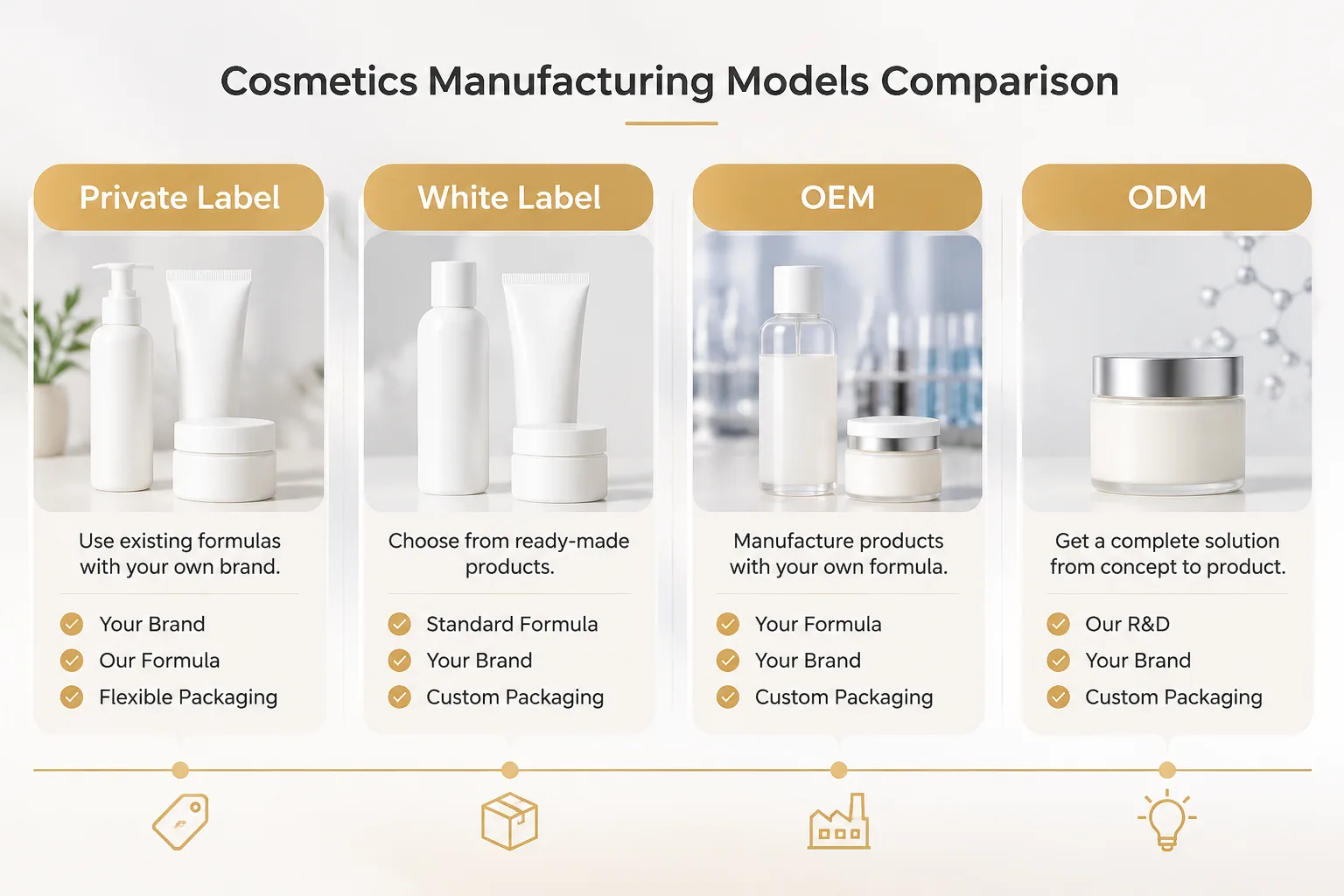
Let me break down each model based on what I see in actual manufacturing projects:
Private Label Skincare
What it means: You select products from the manufacturer's existing range. The manufacturer already has formulas, production setups, and often packaging options. You control branding, product selection, and market positioning.
Best for: Startups and brands prioritizing speed and lower upfront investment. Brands launching their first product line. Brands testing market response before investing in custom formulation.
Typical MOQ: 500–3,000 units per SKU, depending on packaging and formula complexity.
Timeline: 30–60 days from order confirmation to delivery.
Differentiation level: Moderate. You differentiate through packaging, branding, product combinations, and positioning — not formula exclusivity.
OEM (Original Equipment Manufacturing)
What it means: You provide the formula, specifications, ingredients, and production requirements. The manufacturer produces according to your exact instructions. You own the formula.
Best for: Established brands with proprietary formulas. Brands with specific ingredient requirements or therapeutic claims. Brands that have already developed and tested their formula.
Typical MOQ: 3,000–10,000 units per SKU, depending on formula complexity and raw material sourcing.
Timeline: 60–120 days, depending on raw material availability and production scheduling.
Differentiation level: High. You control the formula completely.
Key challenge: You need formula development expertise, stability testing data, and often regulatory pre-clearance before manufacturing starts.
ODM (Original Design Manufacturing)
What it means: The manufacturer develops the product concept, formula, and design. You select from these concepts and brand them as your own. The manufacturer retains formula ownership but may offer exclusivity terms.
Best for: Brands that want unique products without in-house R&D. Brands working with manufacturers that invest heavily in new product development.
Typical MOQ: 2,000–5,000 units per SKU.
Timeline: 45–90 days, depending on how much concept customization you require.
Differentiation level: Moderate to high. You get access to newer formulas and product concepts that may not yet be widely available.
Custom Formulation
What it means: The manufacturer's R&D team develops a unique formula based on your requirements — target ingredients, texture, fragrance, efficacy goals, and market positioning. You typically own or license the formula.
Best for: Brands with clear product differentiation goals. Brands entering markets where formula uniqueness drives competitive advantage.
Typical MOQ: 5,000–10,000 units per SKU, sometimes higher depending on specialized ingredients.
Timeline: 90–180 days, including formula development, stability testing, and sampling rounds.
Differentiation level: Highest. You get a formula designed specifically for your brand.
Key challenge: Higher upfront investment, longer development timeline, and greater technical risk if the formula doesn't perform as expected.
| Manufacturing Model | Formula Control | Typical MOQ | Timeline | Best For |
|---|---|---|---|---|
| Private Label | Manufacturer's existing formulas | 500–3,000 units | 30–60 days | Fast launch, lower investment |
| OEM | You provide formula | 3,000–10,000 units | 60–120 days | Brands with proprietary formulas |
| ODM | Manufacturer develops concept | 2,000–5,000 units | 45–90 days | Access to new product concepts |
| Custom Formulation | Co-developed or exclusive formula | 5,000–10,000+ units | 90–180 days | Maximum differentiation |
Choosing the wrong model creates mismatched expectations. I've seen brands request "private label" but expect full custom formulation at private label pricing and timelines. That's not how manufacturing economics work. Custom formulation requires R&D investment, stability testing, raw material sourcing for specialized ingredients, and production line adjustments — all of which increase cost and MOQ.
Can private label skincare still be differentiated?
One of the most common objections I hear: "If I use private label, won't my products be identical to competitors?" The concern is valid. If differentiation only came from formula exclusivity, private label would be a race to the bottom. But that's not how successful beauty brands actually build differentiation.
Private label skincare can be differentiated through formula selection, texture and sensory profile, fragrance direction, active ingredient emphasis, packaging design, product line structure, target audience positioning, and brand storytelling. Formula exclusivity is only one differentiation lever — and often not the most important one for early-stage brands.
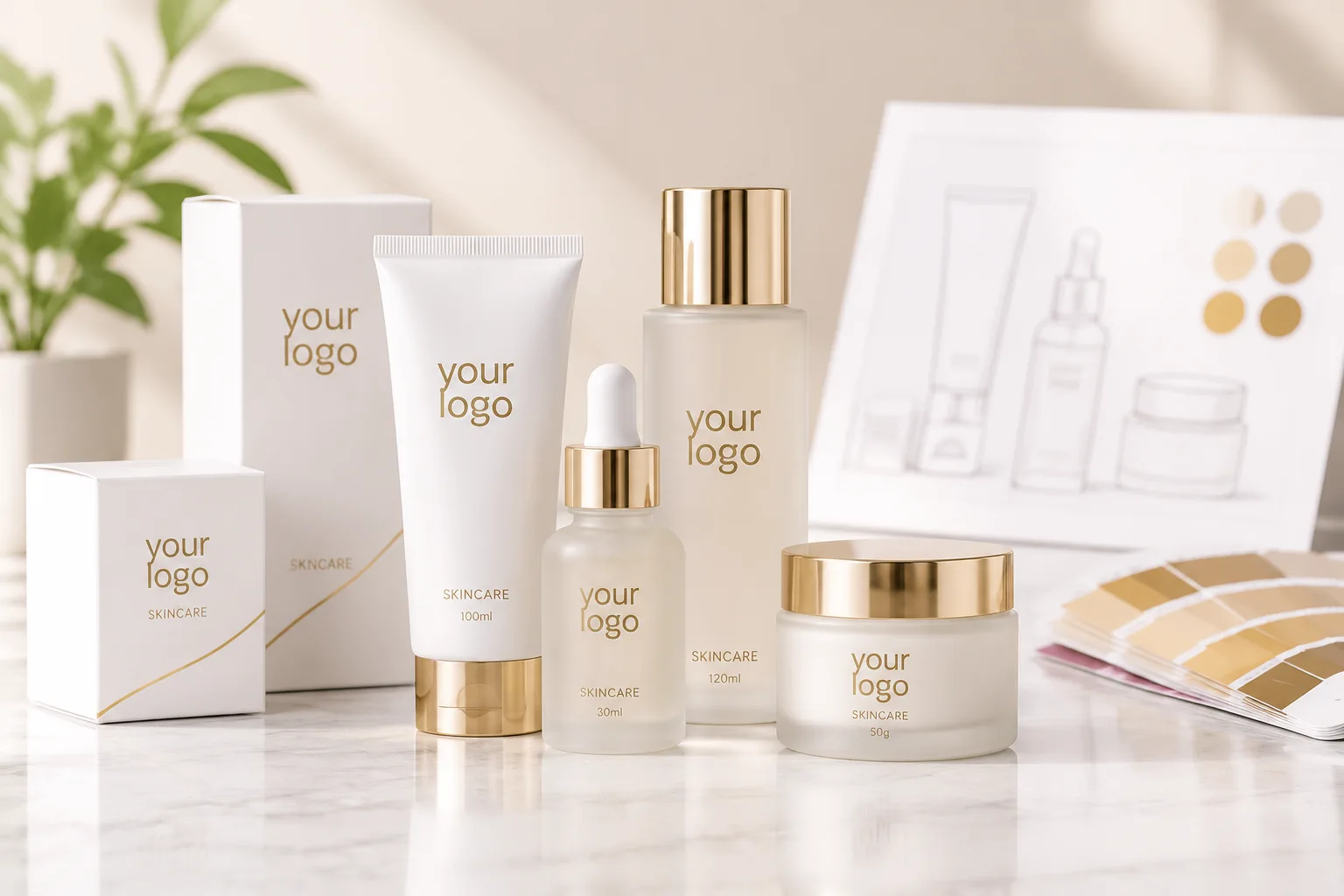
Think about the beauty brands you admire. How many of them have truly unique formulas versus unique positioning, packaging, customer experience, and brand narrative? Most successful beauty brands win through positioning and execution, not formula patents.
Formula selection as differentiation
Even within a manufacturer's existing catalog, you have choices. A manufacturer with 4,000 formulas doesn't mean all clients pick the same 10 products. You can select based on:
- Active ingredient profile: Choose a retinol serum over a vitamin C serum based on your audience's needs
- Texture preference: Select a lightweight gel moisturizer instead of a rich cream for humid climates
- Sensory experience: Pick formulas with specific skin feel, absorption speed, or finish
- Ingredient story: Emphasize natural extracts, peptides, ceramides, or other ingredient narratives
I worked with a European brand launching a men's skincare line. They selected formulas emphasizing lightweight textures, fast absorption, and minimal fragrance — common preferences in male grooming. Another brand targeting mature women selected richer textures, visible peptide content, and formulas focused on barrier repair. Same manufacturer, completely different product experiences.
Texture and fragrance customization
Many manufacturers allow texture and fragrance modifications within existing formulas. You're not creating a new formula from scratch, but you're adjusting the sensory profile:
- Texture adjustments: Making a cream slightly lighter or richer
- Fragrance direction: Choosing between unscented, light floral, citrus, herbal, or custom scent profiles
- Color adjustments: Modifying product color for visual differentiation
These modifications usually don't trigger full custom formulation timelines or MOQs — but they do add differentiation compared to standard versions.
Packaging as a primary differentiator
Packaging is where private label brands often create the most visible differentiation. You control:
- Bottle and jar shapes
- Material choices (glass, plastic, sustainable alternatives)
- Closure types (pumps, droppers, spatulas)
- Label design and printing techniques
- Secondary packaging (boxes, inserts, protective sleeves)
- Gift sets and multi-product bundles
I've seen brands with identical formulas look completely different because one used minimalist glass packaging with metallic accents while another used colorful plastic tubes with bold graphics. Customers perceived them as entirely different products.
Product line structure and positioning
How you combine products into a line creates differentiation:
- Routine-based collections: Morning routine, evening routine, travel sets
- Concern-specific lines: Anti-aging, acne care, sensitive skin, hyperpigmentation
- Demographic targeting: Teen skincare, men's grooming, mature skin, pregnancy-safe products
- Price-tier strategy: Affordable basics, premium treatments, luxury limited editions
You're not just selling individual products — you're selling a system or solution. That's brand differentiation, not formula differentiation.
What should you expect during the private label launch process?
Understanding the process helps you plan realistic timelines and budgets. Most brands underestimate the time between "I want to launch a skincare line" and "products are ready to sell." Let me walk you through the actual steps.
The private label skincare launch process typically includes: initial inquiry and requirements discussion, formula selection and sampling, packaging selection and customization, sample approval, compliance documentation preparation, mass production, quality control, and final delivery. Each stage has decision points that affect timeline, cost, and final product quality.
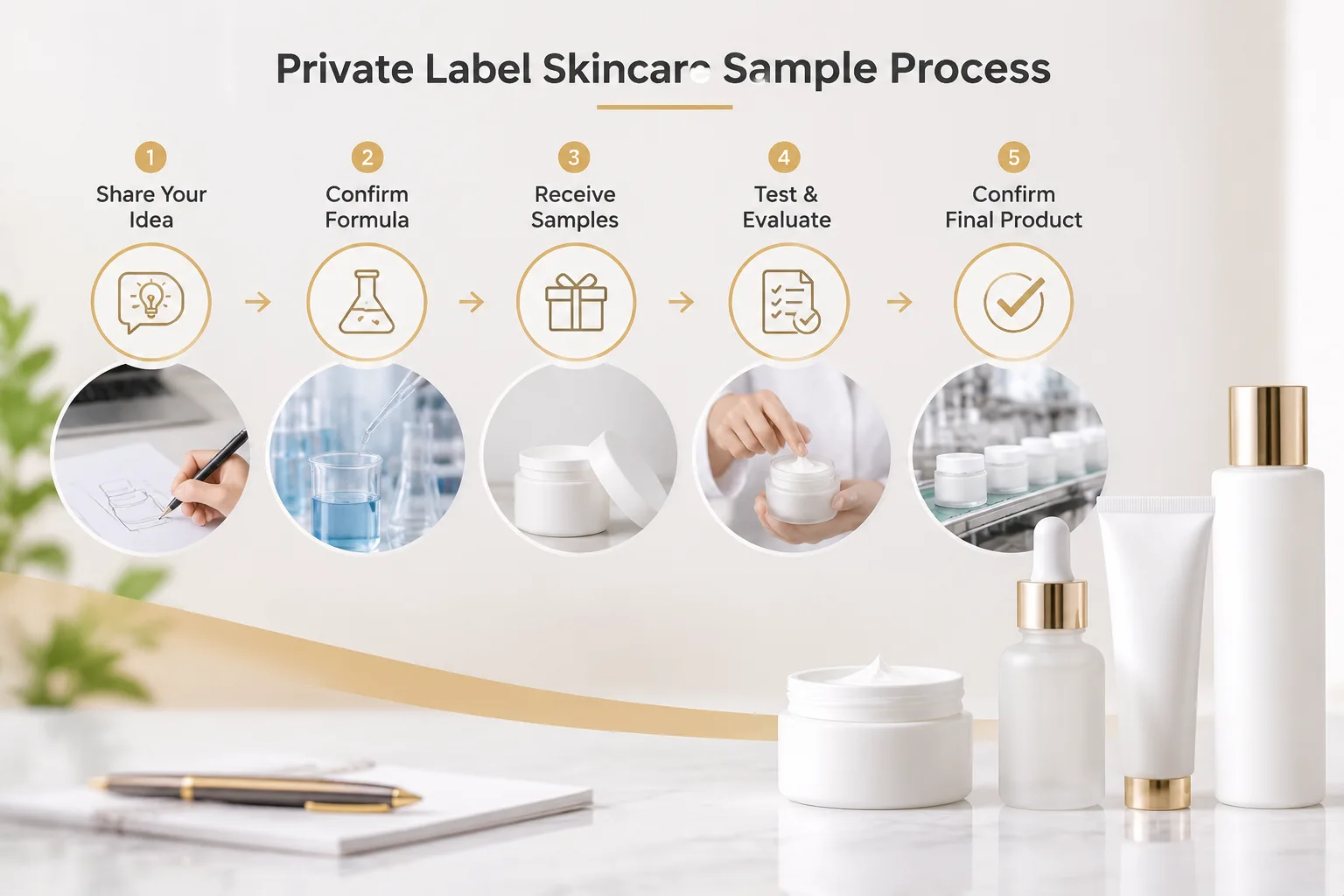
Stage 1: Inquiry and requirements discussion
You contact the manufacturer with your product concept. Expect to discuss:
- Product categories and specific product types you want
- Target market and demographic
- Budget range and order volume expectations
- Packaging preferences and branding direction
- Timeline and launch deadlines
- Compliance requirements for your target market
The manufacturer will explain their capabilities, MOQ structure, pricing framework, and production timelines. This stage usually takes 1–2 weeks of back-and-forth as both sides clarify expectations.
Stage 2: Formula selection and product recommendations
Based on your requirements, the manufacturer recommends formulas. You'll receive:
- Formula descriptions with key ingredients
- Product specifications (texture, viscosity, pH)
- Suggested use cases and target skin types
- Available packaging options
- Pricing estimates based on order volume
If you want formula modifications, this is when you discuss adjustments. The manufacturer will clarify what's possible within their production systems and how modifications affect MOQ and pricing.
This stage can take anywhere from 3 days to 3 weeks, depending on how many product options you evaluate and how quickly you make decisions.
Stage 3: Sampling
Once you select formulas, the manufacturer prepares samples. Sampling usually happens in rounds:
First sampling round: Basic formula samples in standard packaging. You evaluate texture, fragrance, skin feel, and overall product experience.
Second sampling round (if needed): Adjusted samples based on your feedback. Maybe you requested lighter texture, different fragrance, or slight ingredient modifications.
Final sampling round: Samples in your selected packaging with your branding applied. This confirms the complete product experience.
Each sampling round takes 5–15 days depending on formula complexity and packaging availability. Brands often underestimate how many rounds they'll need. Plan for at least two rounds.
Stage 4: Packaging design and customization
While sampling happens, you work on packaging:
- Selecting bottle and jar styles
- Designing labels and printing graphics
- Choosing closures and applicators
- Finalizing secondary packaging and boxes
If you're using standard packaging with custom printing, this is relatively quick. If you're sourcing unique packaging, expect longer lead times and potentially higher MOQs.
Stage 5: Compliance documentation preparation
Depending on your target market, you'll need various documents:
- Certificate of Analysis (COA): Confirms the product meets specifications
- Material Safety Data Sheet (MSDS): Safety information for handling and shipping
- IFRA Certificate: For fragrance compliance in certain markets
- Cosmetic Product Safety Report (CPSR): Required for EU markets
- FDA-related documentation: Depending on U.S. product classification
Some manufacturers provide basic documentation as part of their service. Others charge separately for detailed reports. Clarify this upfront to avoid surprise costs.
Preparing comprehensive documentation can take 2–4 weeks depending on the product and target market requirements.
Stage 6: Mass production
Once you approve final samples and documentation, mass production begins. The manufacturer:
- Sources and inspects raw materials
- Produces the formula in bulk
- Fills products into your packaging
- Applies labels and branding
- Assembles secondary packaging
- Conducts quality control inspections
Mass production timelines vary based on order size and production scheduling:
- Small orders (500–2,000 units): 15–30 days
- Medium orders (2,000–10,000 units): 30–45 days
- Large orders (10,000+ units): 45–60 days
Production schedules also depend on factory capacity and how many other orders are in queue.
Stage 7: Quality control and final inspection
Before shipment, the manufacturer conducts final quality checks:
- Product specification verification
- Microbiological testing (if required)
- Packaging integrity inspection
- Label accuracy verification
- AQL sampling for batch consistency
Some brands hire third-party inspection services to verify quality before shipment. This adds 3–7 days but provides independent verification.
Stage 8: Delivery and logistics
The manufacturer arranges shipping based on your delivery terms:
- FOB (Free on Board): Manufacturer delivers to port, you arrange international shipping
- CIF (Cost, Insurance, Freight): Manufacturer arranges international shipping to your destination port
- DDP (Delivered Duty Paid): Manufacturer handles all shipping and customs clearance to your warehouse
International shipping adds 15–45 days depending on destination and shipping method (air freight vs. ocean freight).
Total timeline from inquiry to delivery
Realistically, expect:
- Fast-track private label (minimal customization): 45–60 days
- Standard private label (moderate customization): 60–90 days
- Custom private label (significant customization): 90–120 days
Brands often assume "30 days" based on manufacturer marketing materials, then feel frustrated when the actual timeline is longer. The timeline depends on how quickly you make decisions, how many sampling rounds you need, and how much customization you require.
What variables affect private label skincare costs?
Pricing is rarely as simple as "price per unit." Multiple variables affect your total cost structure. Understanding these helps you budget accurately and avoid surprises.
Private label skincare costs depend on formula complexity, order volume, packaging selection, customization level, compliance testing requirements, and logistics terms. Unit price decreases with volume, but total upfront investment increases. Budget for both per-unit cost and total launch capital requirements.
Formula complexity and ingredient cost
Base formulas with common ingredients cost less than formulas with expensive actives:
- Basic formulas: Simple cleansers, basic moisturizers, body lotions
- Mid-tier formulas: Serums with vitamins, peptide creams, exfoliating products
- Premium formulas: Advanced peptide serums, growth factor products, specialized treatments
Ingredient cost directly affects pricing. A vitamin C serum costs more than a basic cleansing gel because vitamin C derivatives are more expensive raw materials.
Order volume and MOQ
Private label MOQs typically range from 500 to 3,000 units per SKU. Higher volumes reduce per-unit cost:
| Order Volume | Relative Unit Price |
|---|---|
| 500 units | Baseline (100%) |
| 1,000 units | ~15-20% lower |
| 3,000 units | ~25-35% lower |
| 5,000 units | ~35-45% lower |
But higher volumes mean more upfront capital and inventory risk. A 500-unit order might cost $5,000 total. A 5,000-unit order might cost $30,000 — you save on unit cost but need more capital.
Packaging cost and customization
Packaging often represents 30–50% of total product cost:
- Standard plastic bottles: Lowest cost, widely available
- Glass bottles: Higher cost, premium positioning
- Custom molds: Very high cost, requires tooling investment
- Premium closures: Pumps and droppers add significant cost per unit
If you launch with three products, packaging decisions multiply. Choosing premium glass for all three products significantly increases total cost compared to standard plastic.
Compliance testing and documentation
Basic documentation (COA, MSDS) is usually included. Additional testing costs extra:
- Stability testing: $500–$2,000 per formula
- Microbiological testing: $200–$800 per batch
- CPSR (EU market): $500–$3,000 per product
- Safety assessments: $1,000–$5,000 depending on market requirements
If you're launching in multiple markets with different regulatory requirements, testing costs add up quickly.
Shipping and logistics
International shipping costs depend on:
- Shipping method: Air freight (fast, expensive) vs. ocean freight (slow, economical)
- Order volume: Larger shipments have lower per-unit shipping cost
- Delivery terms: FOB, CIF, or DDP significantly affect your cost responsibility
- Customs and duties: Vary by destination country and product classification
Ocean freight for a 1,000-unit order might cost $500–$1,500. Air freight for the same order might cost $2,000–$5,000.
Hidden costs to budget for
Beyond direct manufacturing costs, budget for:
- Sampling costs: $200–$1,000 depending on how many rounds you need
- Packaging design and artwork: $500–$3,000 if you hire external designers
- Product photography: $500–$5,000 depending on shoot complexity
- Inventory storage: If you can't receive the full shipment immediately
- Regulatory consulting: If you need help navigating market-specific compliance
I've seen brands budget $10,000 for their first product launch, then realize they need $15,000 once they account for sampling, testing, premium packaging, and air freight to meet their launch deadline.
How do you choose the right private label manufacturer?
Not all private label manufacturers are equal. Your choice affects product quality, reliability, communication efficiency, and long-term supply stability. Here's what I recommend evaluating.
Choose a private label manufacturer based on product category specialization, formula range and customization flexibility, quality systems and testing capabilities, compliance documentation support, communication efficiency, production capacity, and track record with brands similar to yours. Price alone is a poor selection criterion.
Product category expertise
Manufacturers specialize. Some focus on skincare. Others specialize in makeup, hair care, or body care. Some handle all categories but have stronger capabilities in specific areas.
Ask:
- What product categories do you manufacture?
- How many formulas do you have in the categories I need?
- Can I see your product catalog or formula list?
- Do you have R&D staff dedicated to skincare formulation?
A manufacturer with 50 skincare formulas and deep expertise will serve you better than a manufacturer with 500 formulas across all categories but limited skincare knowledge.
Formula customization flexibility
Clarify how much customization the manufacturer supports:
- Can you adjust texture and viscosity?
- Can you modify fragrance within existing formulas?
- Can you adjust active ingredient percentages?
- Can you add or remove specific ingredients?
- At what point do modifications trigger custom formulation pricing and MOQ?
Some manufacturers treat any modification as custom formulation. Others allow reasonable adjustments within their private label framework.
Quality systems and certifications
Ask about quality management:
- Do you have GMP (Good Manufacturing Practice) certification?
- Do you have ISO 22716 certification?
- What quality control procedures do you follow?
- How do you handle batch consistency?
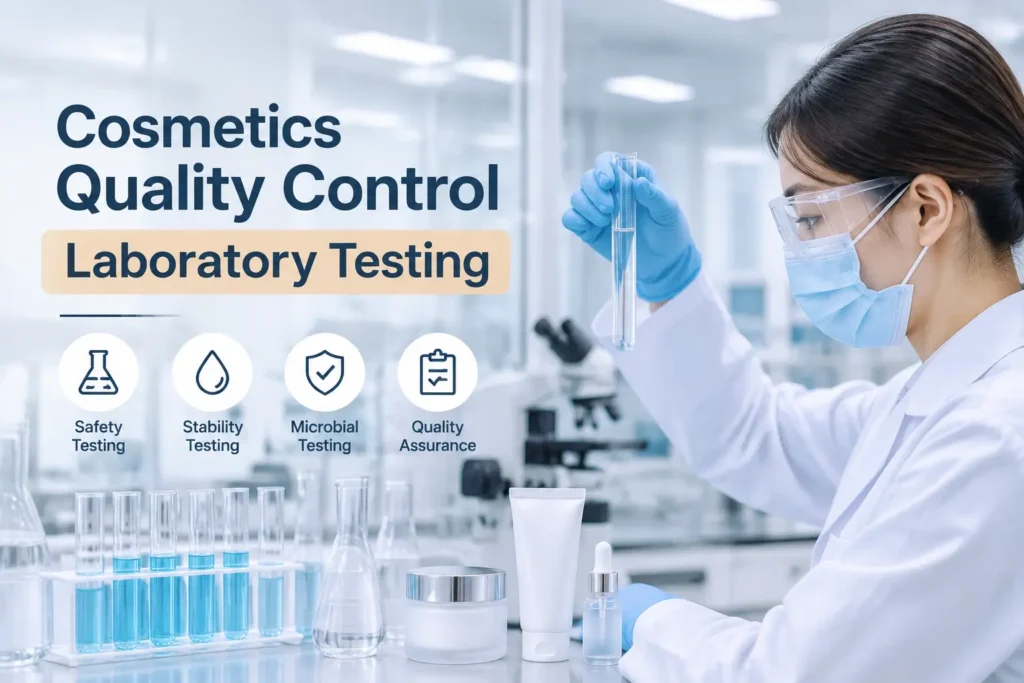
- What testing do you conduct on raw materials and finished products?
Certifications don't guarantee perfect quality, but they indicate systematic quality management practices.
Compliance documentation and regulatory support
Understand what documentation the manufacturer provides:
- What documents are included in your standard service?
- Do you provide COA and MSDS for all products?
- Can you provide IFRA certificates for fragranced products?
- Do you offer CPSR support for EU markets?
- Do you have experience with FDA requirements for U.S. exports?
Some manufacturers have dedicated compliance teams. Others provide basic documents only and expect you to handle market-specific compliance independently.
Communication and responsiveness
Evaluate communication quality during your inquiry:
- How quickly do they respond to your questions?
- Do they provide clear, detailed answers?
- Do they proactively ask about your requirements?
- Is there a language barrier that could cause misunderstandings?
- Do they assign a dedicated contact person for your project?
Poor communication during inquiry predicts poor communication during production. If getting basic information is difficult, working through sampling and production will be frustrating.
Production capacity and reliability
Assess whether the manufacturer can handle your volume and timeline:
- What is your current production capacity?
- What are typical lead times for private label orders?
- How many clients do you currently work with?
- Can you scale production if my orders grow?
- How do you handle production delays or quality issues?
A manufacturer stretched beyond capacity will miss deadlines. A manufacturer with excess capacity might prioritize larger clients over your smaller orders.
Track record with similar brands
Ask for references or case studies:
- Can you share examples of brands you've worked with in my product category?
- Can you provide references I can contact?
- What challenges do brands typically face during their first production run?
- How do you support brands through the launch process?
Manufacturers experienced with startups understand the challenges you'll face. Manufacturers used to only large-volume clients might not have systems for smaller, growing brands.
Red flags to watch for
Be cautious if a manufacturer:
- Promises unrealistic timelines or extremely low pricing
- Provides vague or inconsistent answers about capabilities
- Refuses to provide samples before large orders
- Has no clear quality control procedures
- Requires full payment upfront before production starts
- Cannot provide basic certifications or documentation
Trust your instincts. If communication feels difficult or unclear during the sales process, it won't improve during production.
Frequently Asked Questions
What is the typical MOQ for private label skincare?
Private label MOQ typically ranges from 500 to 3,000 units per SKU, depending on formula complexity, packaging selection, and manufacturer policies. Simpler products with standard packaging often have lower MOQs. Products with custom formulations, specialized packaging, or expensive ingredients usually require higher minimum orders to justify production setup and raw material procurement.
How long does it take to launch a private label skincare line?
Expect 60–90 days from initial inquiry to receiving finished products for a standard private label launch with moderate customization. Fast-track launches with minimal customization may complete in 45 days. Projects requiring extensive formula modifications, custom packaging, comprehensive testing, and complex compliance documentation can take 90–120 days or longer.
Can I get exclusive rights to a private label formula?
Exclusivity terms vary by manufacturer and typically require negotiation, higher MOQs, and additional fees. Some manufacturers offer formula exclusivity within specific markets or product categories. Others do not offer exclusivity for standard private label products. If formula exclusivity is critical to your brand strategy, discuss this requirement early and be prepared for higher investment and volume commitments.
Do private label manufacturers handle regulatory compliance?
Manufacturers typically provide basic product documentation like COA and MSDS, but regulatory compliance responsibility usually belongs to the brand owner. The manufacturer can support compliance preparation by providing necessary documentation, but you remain responsible for ensuring your products meet regulations in your target markets. Some manufacturers offer additional compliance services for specific markets, but this usually costs extra.
How much does it cost to start a private label skincare line?
Initial investment for a private label skincare line typically ranges from $5,000 to $25,000, depending on the number of products, order volumes, packaging choices, testing requirements, and shipping method. A single-product launch with 500 units and standard packaging might cost $3,000–$5,000. A three-product line with 2,000 units each, custom packaging, and comprehensive testing can exceed $20,000. Budget for both product costs and additional expenses like sampling, compliance documentation, photography, and initial marketing.
Conclusion
Private label skincare is neither a shortcut nor a compromise — it's a strategic manufacturing model that helps beauty brands balance speed to market, customization level, capital requirements, and supply chain reliability. The key is understanding what private label actually means for your brand stage, differentiation strategy, and growth trajectory.
You now know that private label sits within a spectrum of manufacturing options, each with different trade-offs around formula control, MOQ, timeline, and cost. You understand that differentiation doesn't require formula exclusivity — packaging, positioning, product combinations, and brand narrative create meaningful competitive advantage. And you've learned what to expect during the launch process, what variables affect costs, and how to evaluate potential manufacturing partners.
If you're ready to explore private label skincare for your beauty brand, reach out to experienced manufacturers with clear questions about capabilities, customization flexibility, quality systems, and compliance support. Request samples, evaluate communication quality, and clarify all cost and timeline expectations before committing.
At Miaolian, we've supported hundreds of beauty brands through their private label launches, from initial product selection through mass production and international shipping. We provide access to over 4,000 proven skincare formulas, flexible customization options, comprehensive quality control, and dedicated project management throughout your launch process. Contact us to discuss your product requirements and learn how private label manufacturing can support your beauty brand goals.
<!--[googlesitekit-end-of-content]-->