I've spent years watching startup founders and experienced distributors wrestle with the same question when they first contact us: Should we launch with private label products, or invest in custom formulation? The confusion is understandable — this decision shapes your budget, timeline, product uniqueness, and supply chain stability. What frustrates me is how often I see brands make the wrong choice for the wrong reasons. Some founders chase formula uniqueness before they've validated the market. Others choose private label thinking it limits their brand's growth, when in reality it just gave them space to focus on positioning. The right answer isn't about quality hierarchy — it's about matching your manufacturing model to your brand stage, risk tolerance, and actual business needs right now.
Private label skincare means launching ready-made formulations under your own brand name and custom packaging, while custom formulation means developing a new formula from scratch based on your product concept. Private label is faster and lower-risk for market entry, while custom formulation offers greater formula differentiation but requires longer development time, higher investment, and clearer product concepts before production.
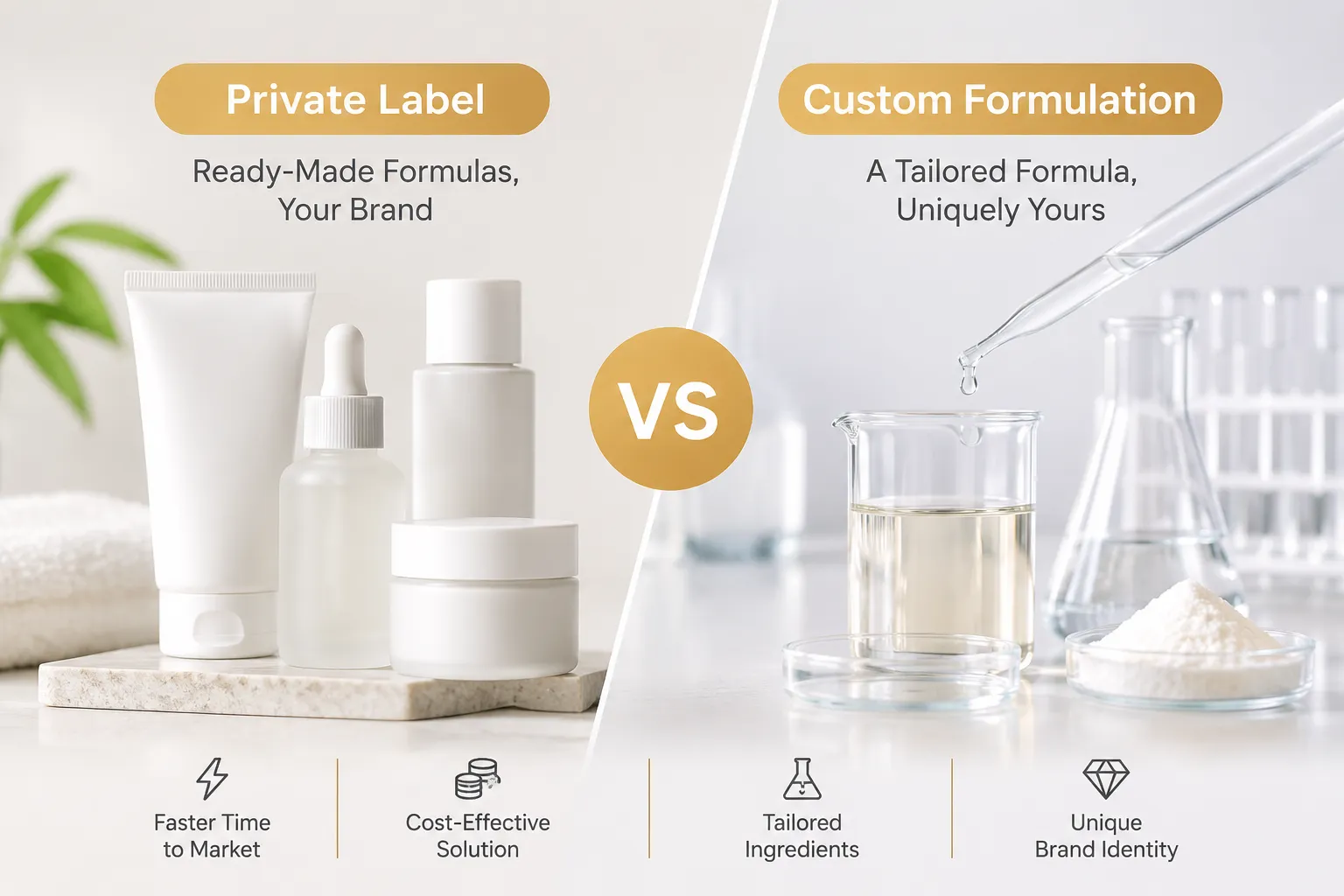
Most skincare founders assume custom formulation automatically means better products. But in client conversations, I've watched businesses struggle with delayed launches, sampling rounds that drag on for months, and MOQ requirements they weren't prepared for. Meanwhile, other brands launch successfully with private label products differentiated through smart positioning, packaging design, and marketing claims — and transition to custom formulation later when they've validated the market. Let me break down both models, the real differences between them, and how to choose the right path for your brand stage.
What Is Private Label Skincare?
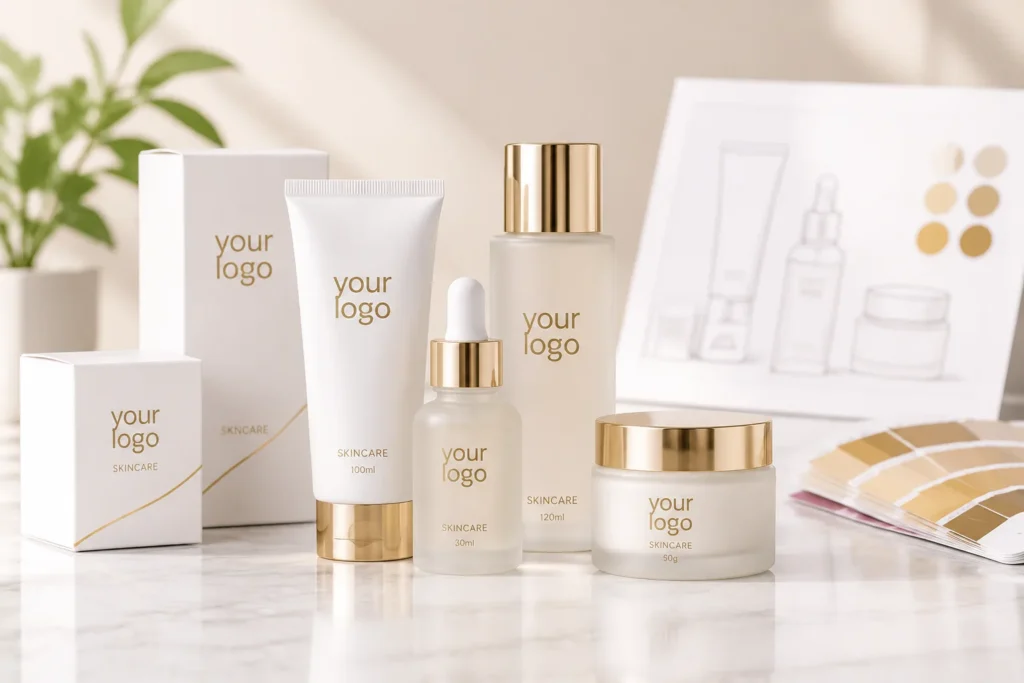
Private label skincare is when you purchase existing, pre-developed skincare formulations from a manufacturer and sell them under your own brand name. The formula is already developed, tested, and ready for production. You customize the branding, packaging design, label content, and product presentation — but the core formulation stays the same as other customers using that formula.
How Does Private Label Skincare Work?
Private label skincare manufacturers maintain a library of proven formulations across different product categories. When you work with a private label model, you select formulas from this library — usually organized by product type (cleanser, serum, cream), skin concern (hydration, anti-aging, brightening), or ingredient focus (vitamin C, hyaluronic acid, retinol).
Here's the typical private label skincare process I walk clients through:
- Formula selection: You review the manufacturer's formula library and select products that match your brand positioning and target skin concerns.
- Sample evaluation: The manufacturer sends samples of the selected formulas for you to test and evaluate.
- Packaging customization: You work with the manufacturer to choose bottles, jars, pumps, labels, and other packaging components.
- Branding and label design: You design or provide label artwork, brand graphics, product names, and claim language for the packaging.
- MOQ confirmation and production: Once you approve samples and finalize packaging, you place an order (usually with a minimum order quantity) and the manufacturer begins mass production.
- Quality control and delivery: The manufacturer completes filling, packaging, quality inspection, and arranges delivery or export.
The formula itself doesn't change — what changes is whose brand name appears on the product.
Benefits of Private Label Skincare
Private label skincare offers several practical advantages, especially for brands launching their first product line or testing new product categories:
Faster time to market: Since the formula is already developed and tested, you skip months of formulation development, stability testing, and adjustment rounds. In my experience, private label products can go from concept to finished product in 4–8 weeks, depending on packaging complexity.
Lower initial investment: You're not paying for custom R&D, proprietary formulation development, or extensive testing. The development cost is already amortized across multiple customers using that formula.
Proven formulations: Private label formulas are already manufactured repeatedly. The manufacturer knows the formula's stability, texture, performance, and production behavior. You reduce the risk of formula failures, separation issues, or unexpected production problems.
Flexible MOQ options: Private label products often have more flexible minimum order quantities compared to custom formulation, since the manufacturer can combine production runs for multiple customers using the same formula.
Focus on branding and marketing: Instead of investing energy in formula development, you can focus on brand positioning, packaging design, marketing strategy, and customer acquisition.
Who Should Choose Private Label Skincare?
Private label skincare works best for specific business situations and brand stages. Here's who I typically recommend this model to:
First-time skincare brand founders: If you're launching your first skincare line, private label reduces complexity, cost, and risk. You can validate your brand positioning, test customer response, and learn the business before investing in custom formulation.
Brands prioritizing fast market entry: If you need to launch quickly — for example, to meet a seasonal opportunity, retail deadline, or market window — private label gives you speed.
Budget-conscious startups: When cash flow is limited and you need to minimize upfront investment, private label offers a lower financial barrier to entry.
Distributors and wholesalers: If you're adding skincare products to an existing distribution network and your differentiation comes from pricing, customer relationships, and market access rather than formula uniqueness, private label is practical.
Brands testing new product categories: If you want to expand into a new product type (for example, adding a body care line when you've only sold facial skincare), private label lets you test the category without committing to full custom development.
What Is Custom Formulation in Skincare?
Custom formulation means developing a new skincare formula from scratch, based on your specific product concept, ingredient preferences, texture requirements, and brand positioning. The formula is created exclusively for your brand and not shared with other customers (unless you choose otherwise).
How Does Custom Skincare Formulation Work?
Custom formulation is a collaborative development process between you and the manufacturer's R&D team. It requires clearer product concepts, more detailed communication, and more patience than private label.
Here's how custom skincare formulation typically unfolds:
- Product brief and concept discussion: You provide detailed information about your product vision — target skin concern, desired texture, key ingredients, sensory experience, target market, and brand positioning.
- Formula development: The manufacturer's R&D team creates an initial formula based on your brief. This stage involves ingredient selection, formulation chemistry, and preliminary stability considerations.
- Sample submission: The manufacturer sends you samples of the first formula version for evaluation.
- Feedback and adjustment: You test the samples and provide feedback on texture, scent, absorption, efficacy perception, packaging compatibility, and any changes you want.
- Iteration rounds: The R&D team adjusts the formula based on your feedback and creates new samples. This process may repeat multiple times until you're satisfied.
- Testing and validation: Depending on market requirements and product claims, the formula undergoes stability testing, compatibility testing, microbial challenge testing, and potentially efficacy testing.
- Packaging development: Simultaneously, you work on custom packaging design, component selection, and label artwork.
- Production and quality control: Once the formula and packaging are finalized, mass production begins with quality control throughout the manufacturing process.
Custom formulation requires more time, communication, and decision-making than private label — but it gives you a formula that belongs exclusively to your brand.
Benefits of Custom Skincare Formulation
Custom formulation offers distinct advantages when formula differentiation matters to your brand strategy:
Formula uniqueness: Your product has a formula that competitors cannot easily replicate. This is valuable when formula composition drives your brand differentiation or marketing claims.
Ingredient control: You choose specific ingredient brands, concentrations, and sources. If your brand is built around specific actives, clean beauty standards, or ingredient transparency, custom formulation gives you full control.
Texture and sensory customization: You can fine-tune texture, scent, absorption speed, and sensory experience to match your brand's aesthetic and customer expectations exactly.
Product positioning: Custom formulation allows you to design products around specific market gaps, customer feedback, or emerging skin concerns that existing private label formulas don't address well.
Long-term IP and brand equity: A custom formula becomes part of your brand's intellectual property. As your brand grows, the formula's uniqueness adds to your brand equity and competitive positioning.
Who Should Choose Custom Formulation?
Custom formulation makes sense in specific brand situations where formula differentiation justifies the additional cost, time, and complexity:
Established brands expanding their product lines: If you already have market traction, customer feedback, and clear product gaps you want to fill, custom formulation lets you address those gaps precisely.
Brands with strong product concepts: If your brand is built around specific ingredient stories, novel combinations, or unique textures that differentiate you in the market, custom formulation supports that positioning.
Brands targeting premium or niche markets: If your customers expect innovation, ingredient transparency, and unique sensory experiences, custom formulation helps deliver on those expectations.
Brands with validated product demand: If you've already tested the market, gathered customer feedback, and confirmed demand for a specific product concept, investing in custom formulation reduces risk.
Businesses planning long-term product lines: If you're building a cohesive product collection with consistent textures, ingredient philosophies, and brand aesthetics across multiple SKUs, custom formulation gives you that consistency.
Private Label vs Custom Formulation: Key Differences
Understanding the practical differences between private label and custom formulation helps you make a realistic decision based on your actual constraints and priorities.
Formula and Ingredient Customization
Private label skincare: The formula is fixed. You cannot change active ingredient concentrations, texture, scent, or formulation structure. Your customization is limited to branding, packaging, and label content. However, some manufacturers offer "semi-custom" options — minor adjustments like adding fragrance, changing color, or adjusting preservative systems within the base formula.
Custom formulation: You control ingredient selection, concentrations, textures, scent profiles, and formula structure. You can specify ingredient brands, request specific actives, adjust viscosity, and fine-tune every aspect of the formula to match your brand requirements.
Decision factor: If your brand differentiation depends on formula uniqueness or specific ingredient combinations, custom formulation is necessary. If differentiation comes from positioning, packaging, and marketing, private label may be sufficient.
Development Time
Private label skincare: Development time is significantly shorter. Once you select a formula, approve samples, and finalize packaging, production can begin. Typical timeline: 4–8 weeks from formula selection to finished products, depending on packaging complexity and production scheduling.
Custom formulation: Development time is longer and less predictable. Initial formula development may take 2–4 weeks, but feedback rounds, adjustments, retesting, and stability validation extend the timeline. Typical timeline: 3–6 months from initial brief to mass production, sometimes longer for complex formulas or extensive testing requirements.
Decision factor: If you have tight launch deadlines, seasonal windows, or limited runway before you need revenue, private label offers speed. If you can afford a longer development timeline, custom formulation becomes viable.
Initial Investment and Costs
Private label skincare: Lower upfront costs. You're not paying for R&D time, formula development, or proprietary testing. Your main costs are product purchase, packaging customization, and minimum order quantity. Initial investment typically ranges from $5,000–$15,000 depending on MOQ, packaging choices, and product categories.
Custom formulation: Higher upfront investment. You pay for R&D time, formula development, sampling rounds, adjustments, stability testing, and potentially efficacy testing. Additionally, MOQ requirements are often higher to justify the custom development cost. Initial investment typically ranges from $15,000–$50,000+ depending on formula complexity, testing requirements, and order volume.
Decision factor: If capital is limited and you need to validate the market before investing heavily, private label reduces financial risk. If you have sufficient budget and formula uniqueness justifies the cost, custom formulation makes sense.
Product Differentiation
Private label skincare: Differentiation comes from branding, packaging design, product positioning, marketing claims, and product combinations — not from formula uniqueness. Multiple brands may use the same formula, so your competitive advantage depends on brand story, customer experience, and market positioning.
Custom formulation: Differentiation is built into the formula itself. You own a unique product that competitors cannot easily replicate. Your competitive advantage includes ingredient selection, texture, sensory experience, and formula-driven claims.
Decision factor: Ask yourself: "Where does my brand truly differentiate?" If it's through positioning, design, and customer relationships, private label works. If formula innovation is core to your brand promise, custom formulation supports that.
Minimum Order Quantity (MOQ)
Private label skincare: MOQ is often more flexible since manufacturers produce the same formula for multiple customers. Depending on the manufacturer and product category, MOQ may range from 500–3,000 units per SKU, sometimes lower for certain products.
Custom formulation: MOQ is typically higher to justify the custom development investment. Manufacturers need to recover R&D costs and ensure production efficiency. MOQ may range from 1,000–5,000+ units per SKU, depending on formula complexity and production setup.
| Factor | Private Label | Custom Formulation |
|---|---|---|
| Formula Customization | Fixed formula, branding/packaging customization | Full control over ingredients, texture, scent |
| Development Time | 4–8 weeks | 3–6 months |
| Initial Investment | $5,000–$15,000 | $15,000–$50,000+ |
| Differentiation Source | Brand, packaging, positioning | Formula uniqueness, ingredient story |
| Typical MOQ | 500–3,000 units/SKU | 1,000–5,000+ units/SKU |
| Risk Level | Lower financial and timeline risk | Higher risk, requires clearer product concept |
Decision factor: If you're testing the market or managing cash flow carefully, lower MOQ in private label reduces inventory risk. If you have capital, validated demand, and distribution channels ready, higher MOQ in custom formulation becomes manageable.
Private Label vs Custom Formulation: Which Is More Cost-Effective?
Cost-effectiveness depends on your brand stage, order volume, and how you define value. Let me break down the cost structures so you can evaluate which model actually saves you money in your situation.
Private Label Skincare Costs
Private label costs are simpler and more predictable. Here's what you're paying for:
Product unit cost: The per-unit cost of the finished product, including formula, filling, and basic packaging. This is usually lower than custom formulation on a per-unit basis since manufacturers spread R&D costs across multiple customers.
Packaging customization: Costs for custom labels, printed bottles or jars, boxes, and any packaging components beyond the manufacturer's standard options.
MOQ commitment: Your minimum order quantity multiplied by the unit cost. This is your main upfront investment.
Shipping and logistics: Delivery costs from the manufacturer to your warehouse or fulfillment center.
No R&D fees: You don't pay separately for formula development, sampling, or testing.
For example, a typical private label facial serum might cost $3–$8 per unit depending on packaging, with an MOQ of 1,000 units. Your total initial investment might be $5,000–$10,000 including packaging and shipping.
Custom Formulation Costs
Custom formulation involves additional cost layers that many founders underestimate:
R&D and development fees: Some manufacturers charge separate fees for formula development, sampling rounds, and R&D time. Others include this cost in the unit price but require higher MOQ to recover development investment.
Testing costs: Stability testing, compatibility testing, microbial testing, and potentially efficacy testing add to the total investment. Depending on the scope, testing can add $2,000–$10,000+ to your development cost.
Higher unit cost: Even if the per-unit cost is similar to private label, the total order cost is higher due to larger MOQ requirements.
Iteration and sampling: Each formula adjustment round may involve additional sampling costs and shipping fees, especially if you're iterating multiple times.
Extended timeline costs: Longer development time means delayed revenue, extended runway burn, and potentially missed market opportunities.
For example, a custom facial serum might cost $4–$10 per unit with an MOQ of 3,000 units, plus $5,000–$15,000 in development and testing fees. Your total initial investment might be $20,000–$45,000.
How to Choose Based on Your Budget
Here's how I typically guide clients through the cost decision:
If your budget is under $10,000: Private label is your realistic option. Focus on strong branding, smart packaging choices, and product positioning to differentiate.
If your budget is $10,000–$25,000: You can choose either model depending on priorities. Private label gives you more inventory and marketing budget. Custom formulation gives you differentiation but tighter cash flow.
If your budget is above $25,000: Custom formulation becomes viable if formula uniqueness supports your brand strategy. You can afford R&D investment and still have capital for marketing and operations.
Think beyond initial cost: Private label offers faster revenue generation since you launch sooner. Custom formulation delays revenue but potentially offers better long-term margins and brand equity.
Don't just compare unit costs — calculate total investment, inventory risk, cash flow timeline, and opportunity cost of delayed launch.
How to Choose the Right Skincare Manufacturing Model for Your Brand
The right choice isn't about which model is "better" — it's about matching the manufacturing model to your brand stage, market strategy, and business constraints. Here's how I recommend thinking through the decision based on different business situations.
For Startups Launching a New Skincare Brand
If you're launching your first skincare brand, you're managing multiple unknowns simultaneously: customer acquisition, pricing strategy, product-market fit, fulfillment logistics, and cash flow. Adding custom formulation complexity on top of that increases risk.
My recommendation for most skincare startups: Start with private label.
Here's why: Private label lets you validate your brand positioning, marketing strategy, and customer acquisition before you invest heavily in custom formulation. You can test different product categories, gather customer feedback, and learn what actually sells — then use that data to inform custom formulation decisions later.
Focus your startup energy on:
- Building a clear brand identity and visual language
- Creating differentiated packaging design
- Developing marketing content and positioning
- Testing customer acquisition channels
- Understanding your target customer's needs
Once you've validated the market and generated revenue, you'll have data to guide custom formulation investments strategically.
Exception: If your brand's core value proposition is formula innovation or specific ingredient combinations that don't exist in private label options, and you have sufficient capital to sustain a longer development timeline, custom formulation may be justified from the start.
For Established Skincare Brands
If you already have market traction, customer feedback, and revenue, custom formulation becomes more attractive. You've reduced several major risks — you know your customers, understand what they want, and have data on what sells.
Consider custom formulation when:
- You have clear customer feedback requesting specific textures, ingredients, or product types not available in private label.
- Your brand has reached a stage where formula uniqueness would strengthen competitive positioning.
- You're ready to invest in long-term brand equity and product differentiation.
- You have sufficient cash flow to absorb the higher upfront investment and longer timeline.
Consider staying with private label or semi-custom when:
- Your differentiation strategy focuses on brand experience, customer relationships, and distribution rather than formula innovation.
- You're expanding into new product categories and want to test market demand before committing to custom development.
- You need to maintain faster product launch cycles to keep up with market trends.
For Wholesalers and Distributors
If you're a distributor or wholesaler adding private label skincare to your product portfolio, your priorities are different from brand founders. You're focused on supply stability, repeat orders, pricing margins, and market demand across multiple customers.
Private label usually makes more sense for distributors because:
- You need predictable supply and consistent product availability for repeat orders.
- Your customers (retailers, resellers) care more about pricing, delivery reliability, and product variety than formula uniqueness.
- You're sourcing multiple product categories and need efficient purchasing processes.
- Lower MOQ and faster reorder times reduce inventory risk.
Custom formulation may work for distributors when:
- You're developing exclusive products for specific retail partners or markets.
- You want to create proprietary product lines that competitors can't easily source.
- You have long-term purchase agreements that justify custom development investment.
For Brands Building a Long-Term Product Line
If you're planning a cohesive product line with multiple SKUs and long-term growth, think about how your manufacturing model supports that vision.
Hybrid approach: Many successful brands start with private label for initial launch, then transition to custom formulation as they grow. This approach reduces early risk while building toward long-term differentiation.
Timeline example:
- Year 1: Launch with 3–5 private label products. Focus on brand building, customer acquisition, and market validation.
- Year 2: Introduce 1–2 custom formulated products based on customer feedback and market gaps. Keep successful private label products in your line.
- Year 3+: Gradually transition more products to custom formulation while maintaining private label for categories where formula differentiation matters less.
This staged approach balances speed, risk, and differentiation over time.
Can You Combine Private Label and Custom Formulation?
One of the most common misconceptions I encounter is that you must choose exclusively between private label and custom formulation. In reality, many successful skincare brands use both models strategically across their product lines.
Starting with Private Label Products
Launching with private label skincare gives you speed and reduces upfront investment. You can establish your brand presence, build customer relationships, and generate revenue while learning what your market actually wants.
What to launch with private label:
- Core product categories with proven demand (cleansers, moisturizers, serums)
- Products where formula differentiation matters less (basic cleansers, toners, body lotions)
- Product categories you're testing for market fit
Focus your private label products on solid, reliable formulations that meet customer expectations. Differentiate through branding, packaging design, product education, and customer experience.
Transitioning to Custom Formulation
As your brand grows and you gather customer feedback, you'll identify opportunities where custom formulation adds real value. This is when transitioning strategically makes sense.
When to transition specific products to custom formulation:
- Customer feedback consistently requests specific textures, ingredients, or sensory experiences not available in private label.
- You identify a market gap where a custom formula could differentiate your brand meaningfully.
- A product category becomes a hero product driving brand identity and customer loyalty.
- You have sufficient sales volume to justify the higher development cost and MOQ.
You don't need to transition your entire product line at once. Move one or two products to custom formulation first, learn the process, and expand gradually.
Building a Hybrid Skincare Product Line
A hybrid product line uses both private label and custom formulation strategically based on each product's role in your brand.
Example hybrid product line strategy:
| Product Category | Manufacturing Model | Reasoning |
|---|---|---|
| Facial Cleanser | Private Label | Reliable formula, differentiation through packaging and scent |
| Vitamin C Serum | Custom Formulation | Hero product, brand differentiator, unique texture and ingredient story |
| Facial Moisturizer | Custom Formulation | Core product with specific texture and ingredient positioning |
| Body Lotion | Private Label | Supporting product, less critical for brand differentiation |
| Eye Cream | Private Label | Testing category demand before custom investment |
This approach lets you invest in custom formulation where it matters most while maintaining efficiency and speed in other categories.
Practical advantage: A hybrid model also gives you supply chain flexibility. If custom formulation development is delayed or production issues arise, you maintain product availability through private label products. Conversely, custom formulated hero products drive brand equity while private label products support product line breadth and revenue.
Why Choose Miaolian for Private Label and Custom Skincare Manufacturing?
At Miaolian, we work with skincare brands, distributors, and wholesalers at different stages — from first-time founders launching initial product lines to established brands developing custom formulations. Our role is to help you choose the right manufacturing model for your brand stage and provide practical solutions throughout the development and production process.
Flexible Private Label and Custom Formulation Solutions
We offer both private label and custom formulation options, which means we can guide you toward the right model for your specific situation rather than pushing one approach.
Private label skincare options:
- Over 4,000 proven formulations across skincare, body care, hair care, and other categories
- Formula library organized by product type, skin concern, and ingredient focus
- Sample evaluation before production commitment
- Flexible MOQ options depending on product category
- Established formulas with proven stability and manufacturing reliability
Custom formulation capabilities:
- 60+ R&D professionals with extensive formulation experience
- 500㎡ dedicated R&D center for formula development and testing
- Custom formula development based on your product brief and brand positioning
- Sampling and iteration process with feedback integration
- Stability testing, compatibility testing, and quality validation
Whether you choose private label, custom formulation, or a hybrid approach, we structure the development and production process around your brand's actual constraints and priorities.
Skincare Product Development and Manufacturing
Our manufacturing capabilities cover the full product development and production process:
Product categories:
- Skincare: Cleansers, toners, serums, creams, lotions, and other facial care products
- Face and body masks: Sheet masks, hand masks, foot masks, eye masks, neck masks
- Body care: Body lotions, body wash, body scrubs, body oils, hand and foot care
- Hair care: Shampoos, conditioners, hair masks, scalp care
- Other categories including soap, fragrance, and home cleaning products
Manufacturing facilities:
- Four specialized manufacturing bases covering different product categories
- GMP-standardized manufacturing environments
- Class 100,000 clean filling workshops
- Daily emulsification capacity of up to 180 tonnes
- Filling capacity of up to 10,000 bottles per day
- 12 production lines supporting flexible production scale
Packaging and Branding Customization
Whether you choose private label or custom formulation, packaging design and branding are critical for product differentiation. We provide comprehensive packaging customization through our packaging supply chain system.
Packaging options:
- Bottles, jars, tubes, pumps, droppers, and other primary packaging
- Custom label printing and design
- Folding cartons, boxes, and gift sets
- Flexible branding and graphic design integration
Our packaging customization process supports both standard options for faster production and fully custom packaging design for brands building unique visual identities.
From Product Development to Mass Production
We provide integrated support throughout the manufacturing process:
- Product consultation: Discuss your brand positioning, product concept, target market, and manufacturing model options.
- Formula selection or development: Choose from existing formulas (private label) or develop custom formulations based on your brief.
- Sampling and evaluation: Review samples and provide feedback for adjustments if needed.
- Packaging and branding: Finalize packaging design, label content, and branding elements.
- Testing and quality control: Conduct relevant testing (stability, microbial, compatibility) and quality checks throughout production.
- Mass production: Manufacture your products with quality control at every stage.
- Export and delivery support: Arrange delivery, export documentation, and shipping logistics.
Our goal is to reduce complexity and uncertainty in the manufacturing process so you can focus on building your brand and reaching customers.
Frequently Asked Questions (FAQs)
What Is the Difference Between Private Label and Custom Formulation Skincare?
Private label skincare means purchasing ready-made formulations from a manufacturer and selling them under your own brand name with custom packaging. Custom formulation means developing a unique formula from scratch based on your product concept and ingredient preferences. Private label is faster, less expensive, and lower risk, while custom formulation offers greater formula differentiation but requires longer development time and higher investment.
Is Private Label Skincare Cheaper Than Custom Formulation?
Yes, private label skincare typically costs less than custom formulation. Private label eliminates R&D fees, formula development costs, and extensive testing expenses. Additionally, MOQ requirements are often lower, reducing initial inventory investment. Custom formulation involves higher upfront costs for development, sampling, iteration, and testing, plus typically higher MOQ requirements to justify the investment.
Can I Customize the Formula of a Private Label Skincare Product?
Most private label formulas cannot be significantly customized since they are standardized for multiple customers. However, some manufacturers offer "semi-custom" options such as adjusting fragrance, changing product color, or modifying preservative systems within the base formula. If you need substantial ingredient changes, concentration adjustments, or texture modifications, custom formulation is necessary.
How Long Does Custom Skincare Formulation Take?
Custom skincare formulation typically takes 3–6 months from initial product brief to mass production. This timeline includes formula development (2–4 weeks), sampling and feedback rounds (4–8 weeks), formula adjustments and iteration (2–6 weeks), stability testing (4–12 weeks depending on test duration), and final production preparation. Complex formulas, extensive testing requirements, or multiple iteration rounds can extend this timeline further.
What Is the MOQ for Private Label Skincare Products?
MOQ for private label skincare varies depending on the manufacturer, product category, and packaging choices. Typical MOQ ranges from 500–3,000 units per SKU. Some manufacturers offer lower MOQ for certain products or higher MOQ for more complex formulations. Custom formulation usually requires higher MOQ, often 1,000–5,000+ units per SKU, to justify the custom development investment.
Can Startups Work with Custom Skincare Manufacturers?
Yes, startups can work with custom skincare manufacturers if they have sufficient budget, clear product concepts, and realistic timelines. However, most skincare startups benefit more from private label initially to reduce risk, validate the market faster, and preserve capital. Custom formulation makes more sense for startups with strong funding, differentiated product concepts that justify the investment, or founders with deep industry experience.
Can I Sell Private Label Skincare Products Under My Own Brand?
Yes, private label skincare is specifically designed for brands to purchase products and sell them under their own brand name. You customize the packaging, labels, product names, and branding while the manufacturer supplies the formula and production. The products become yours to sell through your own channels, and customers see your brand, not the manufacturer.
Should I Choose an OEM or ODM Skincare Manufacturer?
OEM (Original Equipment Manufacturer) means the manufacturer produces products according to your specifications and formulas. ODM (Original Design Manufacturer) means the manufacturer provides existing formulas and product designs you can brand as your own. If you have custom formulas or detailed specifications, OEM is appropriate. If you're selecting from existing formulas (private label), ODM is more accurate. Many manufacturers, including Miaolian, offer both OEM and ODM services to support different brand needs.
Conclusion: Which Skincare Manufacturing Model Is Right for Your Brand?
The choice between private label and custom formulation isn't about better or worse — it's about matching the manufacturing model to your brand stage, budget, timeline, and differentiation strategy. Private label offers speed, lower risk, and practical entry into the skincare market, making it ideal for startups, brands testing new categories, and businesses where formula uniqueness is not the primary differentiator. Custom formulation provides formula ownership, ingredient control, and product differentiation, making it valuable for established brands, businesses with validated product concepts, and brands where formula innovation drives competitive positioning.
Most importantly, you're not locked into one model forever. Many successful skincare brands start with private label to validate the market and generate revenue, then transition strategically to custom formulation as they grow and identify where formula differentiation adds real value. A hybrid approach — using private label for some products and custom formulation for hero products — balances efficiency, risk management, and brand differentiation.
If you're ready to explore private label or custom formulation options for your skincare brand, contact Miaolian to discuss your product concepts, manufacturing needs, and brand goals. We'll help you evaluate which model makes sense for your situation and guide you through the development and production process.
<!--[googlesitekit-end-of-content]-->