Finding the right Chinese cosmetics manufacturer can feel overwhelming — hundreds of suppliers, similar-looking catalogs, and prices that vary wildly with no clear reason. One wrong decision early in your supplier selection process can cost you months of delays, failed samples, or a production run you cannot sell. The good news is that a structured evaluation approach can significantly reduce that risk.
Choosing the right Chinese cosmetics manufacturer is not about finding the lowest quote. It is about matching the supplier's cooperation model, product complexity, packaging options, MOQ structure, and long-term supply reliability to your brand's current stage and market requirements. Buyers who evaluate these factors systematically are far less likely to face costly surprises after production begins.
The factors that separate a reliable China cosmetics manufacturing partner from an unreliable one are rarely visible in a catalog or an initial price quote. The sections below break down exactly what to evaluate, verify, and ask — before you commit.
Introduction – Why Choosing the Right Cosmetics Manufacturer Matters
Many buyers approach supplier selection as a simple procurement exercise: collect quotes, compare prices, pick the cheapest option. That approach works for commodity products. It rarely works for beauty and personal care manufacturing.
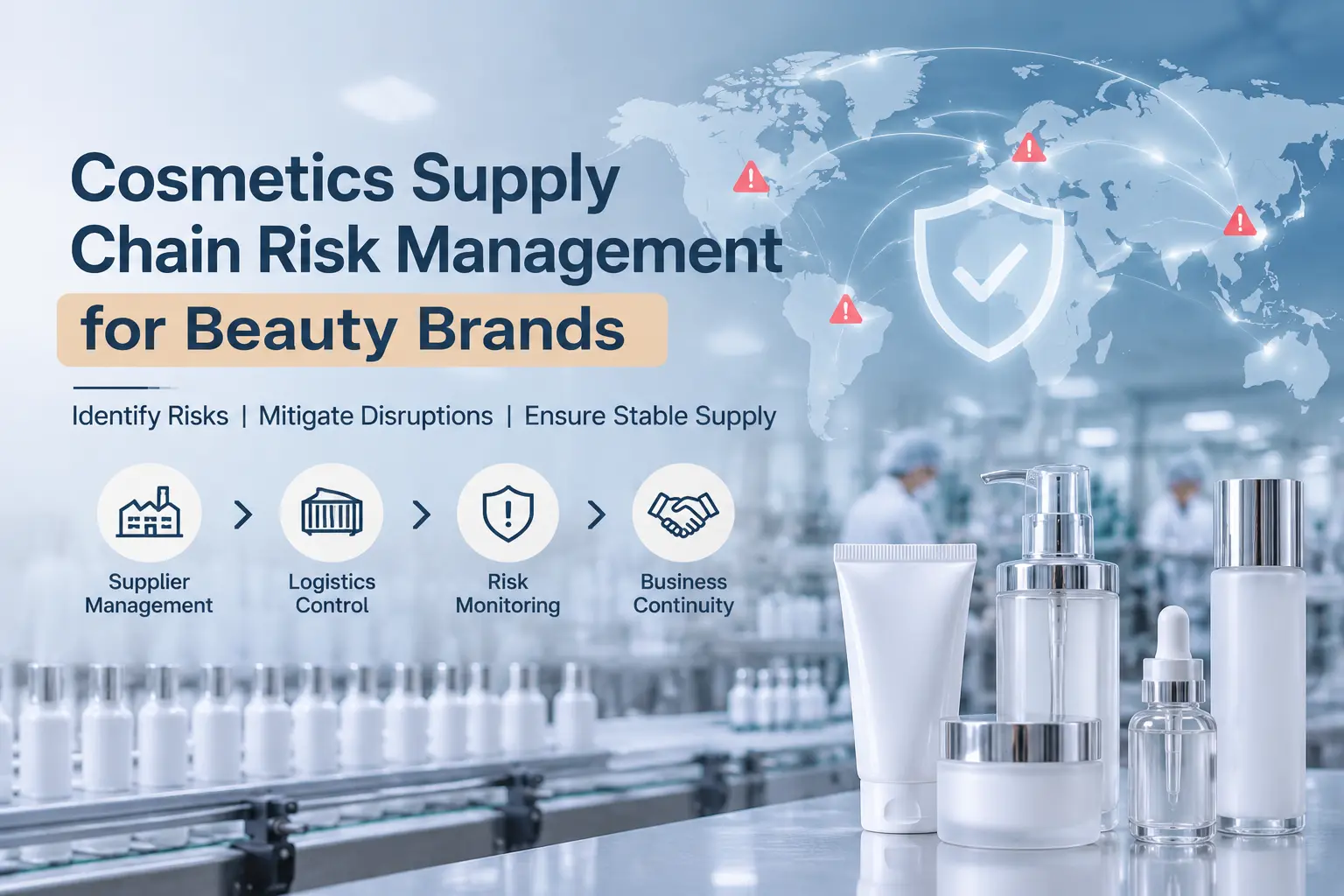
The real risk is not the upfront price. The real risk is what happens after you approve a sample and place your first production order. Supply chain failures in cosmetics tend to show up at the worst possible moments — inconsistent batch quality, packaging components that go out of stock, lead times that stretch without warning, or regulatory documentation that is missing for your target market.
Why Supplier Selection Is a Strategic Decision
From my perspective working in cosmetics OEM/ODM manufacturing, the buyers who run into the most trouble are rarely the ones who asked too many questions. They are the ones who did not ask enough questions early enough. A few patterns I observe repeatedly:
- Buyers who choose based on sample quality alone — without checking whether that quality can be maintained at production scale.
- Buyers who approve a price without understanding what it includes — formula cost, packaging sourcing, testing, labeling, and documentation are often quoted separately or not at all.
- Buyers who underestimate regulatory complexity — a product that sells freely in one market may require additional testing, labeling, or documentation in another.
Buyers who treat the first order as a test — but have not established what "passing the test" actually means before they order. None of these mistakes require specialized technical knowledge to avoid. They require a clearer decision framework before you start reaching out to suppliers.
Understand Your Business Needs Before Finding a Manufacturer
Before you evaluate any supplier, you need to be clear about what you are actually asking them to do. This sounds obvious. In practice, many buyers skip it.
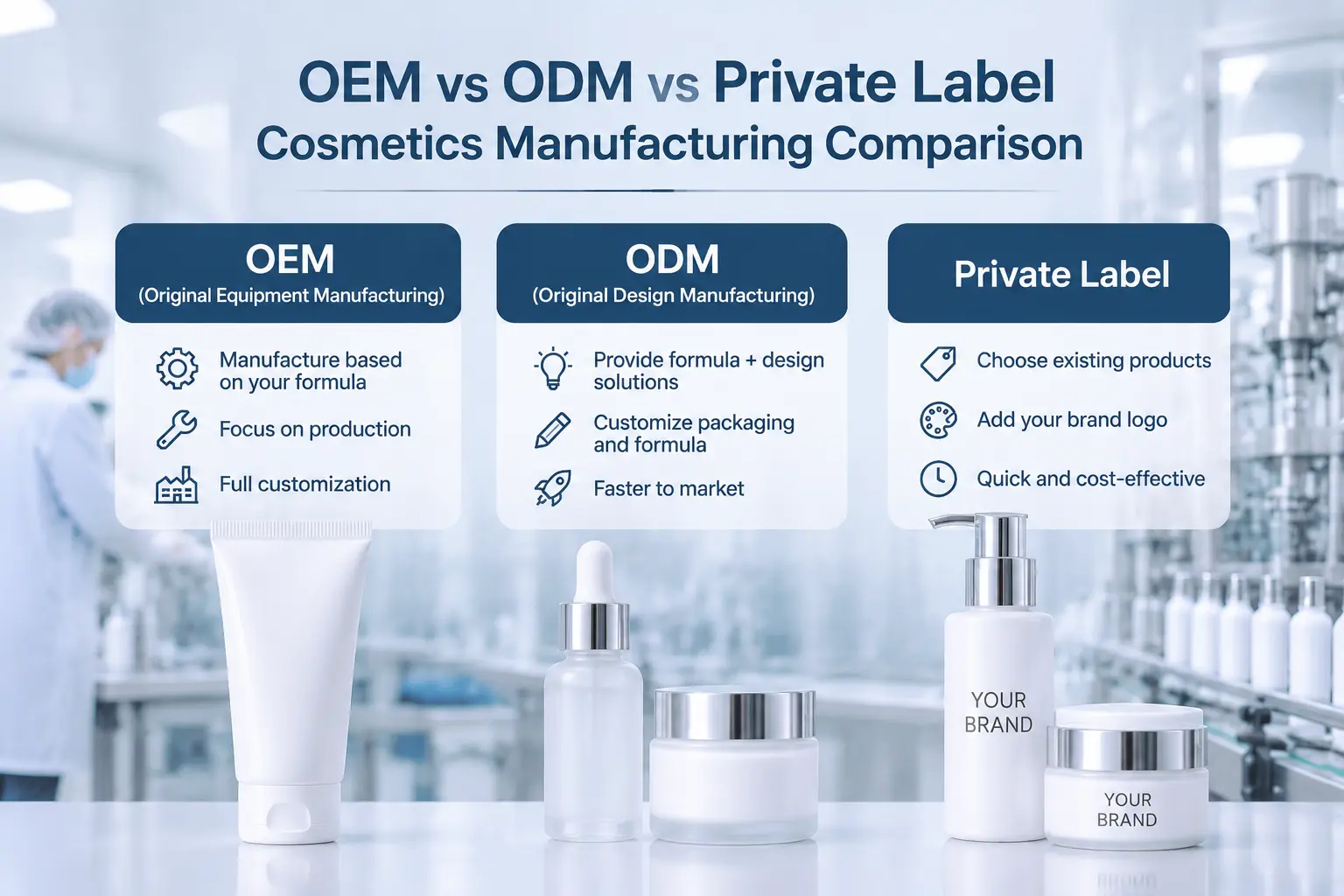
The cooperation model you need — OEM, ODM, private label, or custom formulation — determines the level of supplier capability required, the development timeline, the upfront costs, and the degree of product differentiation you can achieve.
The Four Cooperation Models, Compared
| Cooperation Model | Who Provides the Formula | Customization Level | Development Time | Typical MOQ Complexity |
|---|---|---|---|---|
| OEM | Buyer | High | Longer | Variable |
| ODM | Manufacturer | Medium | Moderate | Lower |
| Private Label | Manufacturer (ready) | Lower | Short | Often lower |
| Custom Formulation | Developed jointly | Very high | Longest | Higher |
Each model has different implications for your budget, timeline, and the kind of supplier expertise you actually need. OEM manufacturing means you provide the formula and the supplier manufactures to your specifications. You need a supplier with strong process engineering, quality control, and packaging execution — not necessarily deep R&D capability. ODM manufacturing means the supplier provides proven formulas that you brand as your own. This is faster and lower risk for buyers launching their first product line. But you need to verify whether the formula is genuinely tested, stable, and appropriate for your target market. Private label is the fastest route to market. You select from existing, ready-to-customize products. The tradeoff is lower product differentiation. Custom formulation development gives you the highest level of differentiation but requires the most supplier capability, the longest development timeline, and the highest sampling and development cost. It is the right choice for brands building a defensible product identity — not for buyers trying to move quickly on a tight budget.
Questions to Answer Before You Start
- What is your target market, and do you understand its regulatory baseline?
- Do you have an existing formula, or do you need the supplier to provide one?
- What is your first-order volume, and what do you expect your repeat order volume to be?
- How much packaging customization do you need?
What is your acceptable lead time from order confirmation to delivery? Answering these questions honestly before contacting suppliers will immediately narrow your shortlist and make your evaluations more productive.
8 Key Factors to Consider When Choosing a Cosmetics Manufacturer in China
Manufacturing Capabilities and Factory Scale
A supplier's physical manufacturing scale matters — but not in the way many buyers assume. Bigger is not always better, especially for emerging brands with smaller initial orders. What matters is whether the supplier's production capacity, clean room standards, and equipment are appropriate for the product categories and volumes you need. Key questions to ask:
- Does the supplier operate dedicated production lines for different product categories?
- What are their clean room classifications, and are they appropriate for your product type?
- What is their daily or monthly production capacity, and can they accommodate both small runs and scale-up orders?
- Do they have GMP-standardized manufacturing environments? From what I have seen inside our own facilities, buyers often underestimate how much specialized infrastructure matters for specific product types. Emulsification capacity, filling line configuration, and clean room standards differ significantly between, say, a water-based serum and a lipstick or a sheet mask. A supplier that is excellent at one category may not have the right setup for another. Things to verify:
- Request a factory tour, either in person or via a live video walkthrough.
- Ask to see the specific production area relevant to your product, not just the general facility.
- Ask about their batch record documentation practices.
Product Quality Control and Certifications
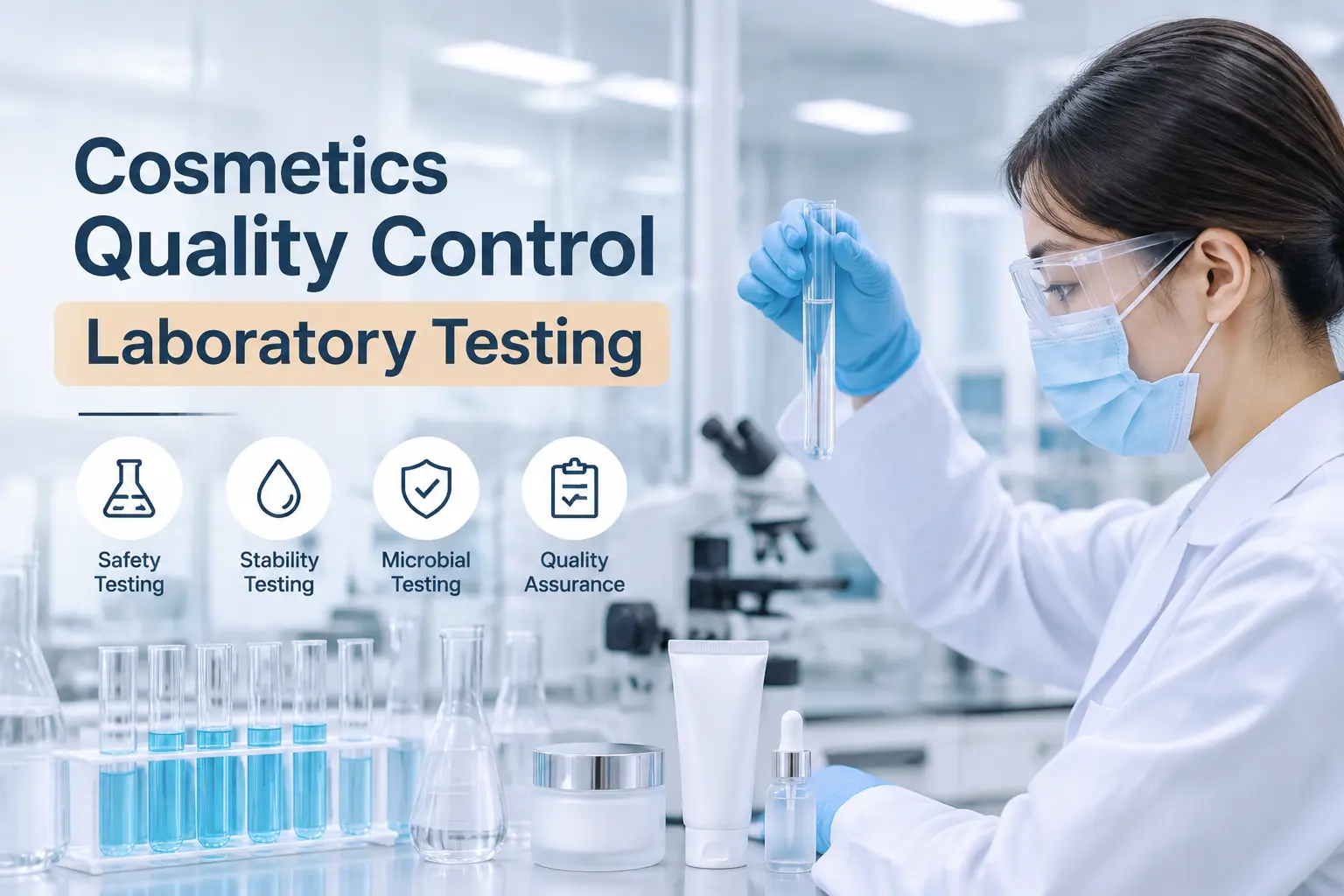
Quality control is one of the areas where buyers are most frequently misled — not because suppliers lie, but because "quality control" means different things to different people. A reliable cosmetics manufacturer should have a multi-stage quality control system covering incoming raw materials, in-process monitoring, semi-finished product testing, finished product inspection, and final batch release documentation.
What a credible QC system looks like:
- Incoming raw material inspection with Certificates of Analysis (COA) verification
- In-process checks for key parameters such as pH, viscosity, and colour consistency
- Microbiological testing on finished products
- Stability testing protocols
- AQL sampling before packaging
- Full batch record documentation before product release Regarding certifications: suppliers may reference ISO 22716, GMPC, ISO 9001, or FDA-related standards. These certifications are worth noting — but buyers should verify their scope and validity directly, ideally with the help of a qualified third party. A certificate on a marketing brochure is not the same as a currently valid, audited certification. Do not rely on certification claims alone. Ask to see documentation. Ask what products and manufacturing lines the certification covers. Ask whether the certification is current.
R&D and Formula Development Capabilities
If you need anything beyond a standard ready formula — a modified formulation, a new active ingredient, a specific texture or finish — your supplier's R&D capability becomes critical. What to evaluate:
- How many R&D professionals does the supplier employ?
- Do they have a dedicated R&D facility?
- How large is their existing formula library, and how recently have formulas been validated?
- Can they develop to your brief, or only offer modifications to existing formulas?
- How do they handle formula IP — do they offer exclusivity agreements? A large formula library is genuinely useful because it shortens development time and reduces sampling cost. But it is only valuable if those formulas have been tested for stability and are actively maintained. One important caution: if a supplier cannot clearly explain the development process — including timelines, testing stages, and decision points — that is a warning sign, regardless of how impressive their catalog looks.
Product Customization and Packaging Options
Packaging is frequently the most underestimated variable in cosmetics product development. A beautiful product concept can stall for weeks because a chosen packaging component is out of stock, requires a minimum order the buyer cannot meet, or is incompatible with the formula. What to evaluate:
- Does the supplier have an in-house packaging supply chain, or do they outsource entirely?
- What customization options are available — shape, material, colour, label printing, secondary packaging?
- What are the packaging MOQs, and do they align with your product order volume?
- Can they perform packaging compatibility testing? Integrated packaging supply chains generally reduce coordination risk and often improve lead times. If your supplier sources packaging from multiple external vendors without direct oversight, ask how they manage quality and availability across those vendors.
MOQ and Pricing Transparency
MOQ is one of the most common points of confusion between buyers and suppliers. The advertised MOQ is often not the real MOQ once you factor in packaging customization, formula development, and specific ingredient requirements.
How to read MOQ structures honestly:
| Variable | Why It Affects MOQ |
|---|---|
| Formula type | Custom formulas often require higher minimum batch sizes |
| Packaging customization | Custom packaging components carry their own MOQs |
| Testing requirements | Some testing protocols require minimum batch quantities |
| Active ingredients | Specialty ingredients may require minimum purchase volumes |
Similarly, pricing transparency matters. A low unit price is often offset by development fees, sampling costs, testing fees, documentation fees, or packaging costs that are not included in the initial quote. Ask for an itemized cost breakdown, not just a unit price.
Production Capacity and Delivery Time
Lead time is not a fixed number — it depends on order volume, formula complexity, packaging availability, production scheduling, and seasonal demand. What to establish clearly:
- What is the realistic lead time for your specific product and order size?
- How is production scheduled during peak seasons?
- What is the supplier's policy if lead time extends beyond the agreed timeline?
- Do they carry buffer stock for key packaging components? Suppliers with strong production planning systems will be able to give you a detailed production schedule with milestone dates. Those who cannot give you specifics beyond a general number of weeks are often not planning at that level of detail.
Export Experience and Regulatory Compliance
A supplier's export experience is directly relevant to how smoothly your shipments clear customs and how reliable their documentation support is. What to verify:
- How many export markets does the supplier currently serve?
- Can they provide market-specific documentation support — such as COA, MSDS, CPSR support, or IFRA certificates where applicable?
- Do they have experience with the specific regulatory requirements of your target market? An important caution: documentation support is not the same as regulatory advice. A supplier can help you prepare standard documentation. Whether that documentation satisfies the specific requirements of your market and product category is a question for a qualified regulatory consultant. Do not ask a manufacturer to make compliance decisions that require a licensed professional.
Communication and After-Sales Support
This factor is consistently underweighted by buyers who are focused on price and product. Communication capability directly affects how effectively you can manage sampling rounds, resolve quality issues, and handle repeat orders. What to evaluate:
- Is there a dedicated account manager for your project?
- What communication channels do they use, and how quickly do they respond?
- How do they handle quality disputes or non-conforming batches?
What support do they provide for repeat orders — formula consistency, packaging continuity, batch documentation? A supplier who is responsive and transparent during the inquiry and sampling phase but becomes difficult to reach after payment is a pattern worth watching for. Ask for references from existing customers if possible.
How to Verify Whether a Chinese Cosmetics Manufacturer Is Reliable
Verifying a supplier's reliability requires more than reviewing their website or catalog. Here are practical steps buyers can take. Request and verify documentation:
- Business license and company registration documents
- Current certifications with scope details
- Quality manual or QC procedure summary
- Sample batch records or COA examples (redacted as appropriate) Conduct a factory audit:
- In-person audits are the most reliable method
- If travel is not possible, a third-party audit conducted by an independent inspection company is a credible alternative
- Video walkthroughs are useful for initial screening but should not replace a formal audit for significant supplier commitments Evaluate the sampling process:
- How many sampling rounds does the supplier expect?
- Do they provide testing data alongside samples?
- Are they transparent about what the sample represents in terms of production-scale replication? Check their production references:
- Ask for references from existing B2B customers in markets similar to yours
- Look for signs of long-term customer relationships, not just transactional orders Use third-party verification where appropriate:
- Platforms such as Alibaba or Global Sources provide some verification, but these should be treated as a starting point, not a final verification
For significant commitments, engage an independent inspection or sourcing agent
Common Mistakes to Avoid When Choosing a Cosmetics Supplier in China
Based on what I have observed across the inquiry-to-production cycle, these are the most consistent mistakes buyers make. Choosing on price alone. A lower unit price frequently comes with higher total cost once development fees, testing, packaging, documentation, and re-sampling rounds are factored in. Approving samples without confirming production scalability. A sample can be made under controlled, hand-crafted conditions that cannot be replicated at production scale. Ask explicitly: "Is this sample produced under production-equivalent conditions?" Skipping the cooperation model discussion. Buyers who have not decided whether they need OEM, ODM, private label, or custom formulation often waste weeks of communication because both sides are talking about different products. Overlooking regulatory requirements early. Discovering that your target market requires additional testing, labeling changes, or documentation after production is complete is expensive. Build regulatory due diligence into your pre-production timeline. Underestimating MOQ reality. The number quoted on a supplier's website is often an ideal minimum. Realistic MOQs for a specific formula with custom packaging and testing requirements may be significantly higher. Not defining quality acceptance criteria upfront. If you have not agreed in writing on what a conforming batch looks like — pH range, viscosity tolerance, colour specification, fill weight tolerance — disputes become very difficult to resolve fairly.
Why Work with an Experienced OEM/ODM Cosmetics Manufacturer?
An experienced OEM/ODM cosmetics manufacturer brings a combination of capabilities that individual specialty suppliers typically cannot match: formula depth, packaging supply chain integration, quality systems, and export documentation experience within a single operation. The practical advantages include:
- Faster development cycles because existing, tested formulas reduce development time compared to building from scratch
- Lower sampling risk because production processes are already validated for a range of product types
- Integrated packaging sourcing that reduces coordination complexity and packaging compatibility risk
- Quality systems that have been built and refined across multiple product categories and customer requirements
Export documentation familiarity across multiple international markets For emerging brands and e-commerce sellers specifically, working with a manufacturer who has handled the full range of project stages — from brief to bulk shipment — means you benefit from accumulated process knowledge rather than learning through expensive errors. That said, experience alone is not a guarantee. An experienced manufacturer that is not the right fit for your product category, your order volume, or your customization requirements will still produce poor outcomes. The goal is not simply to find an "experienced" supplier — it is to find one whose experience is specifically relevant to what you are trying to build.
Questions to Ask Before Partnering with a Cosmetics Manufacturer
Before finalizing any supplier relationship, work through the following structured question list. These are not exhaustive, but they cover the highest-risk areas. On manufacturing capability:
- Which product categories do you specialize in, and what percentage of your production volume do they represent?
- Can you show me the specific production area and equipment for my product type? On quality control:
- What does your QC process look like from raw material intake to finished product release?
- Can you share an example batch record or COA (redacted)?
- How do you handle non-conforming batches? On formula and R&D:
- Is the formula I will be sampling production-validated, or is it a development formula?
- What is your process for formula IP protection? On MOQ and pricing:
- What is the realistic MOQ for my specific product including packaging and testing requirements?
- Can you provide an itemized cost breakdown? On lead time:
- What is the realistic production timeline for my order size and product type?
- What factors are most likely to extend that timeline? On export and compliance:
- What documentation can you provide for my target market?
- Have you exported to [specific market] before? On communication:
- Who will be my primary point of contact throughout the project?
What is your response time commitment?
7 Frequently Asked Questions
What is the difference between OEM and ODM cosmetics manufacturing?
OEM manufacturing means the buyer provides the formula and the manufacturer produces to those specifications. ODM manufacturing means the manufacturer provides an existing, proven formula that the buyer brands as their own. OEM requires more buyer input and development time. ODM is typically faster and lower cost upfront.
What certifications should I look for when choosing a Chinese cosmetics manufacturer?
Relevant certifications may include ISO 22716, GMPC, ISO 9001, and FDA-related compliance documentation. However, buyers should verify the scope and current validity of any certifications directly, rather than relying on catalog claims. Consult a qualified regulatory professional for market-specific compliance requirements.
What is a realistic MOQ for private label cosmetics from China?
MOQ varies significantly depending on the formula, packaging type, customization level, and testing requirements. Advertised minimums are often not the actual minimums once all variables are accounted for. Discuss your specific product requirements with the supplier and ask for a detailed MOQ breakdown before comparing suppliers.
How do I verify that a Chinese cosmetics manufacturer is legitimate?
Request business registration documents and current certifications with scope details. Conduct a factory audit in person or through an independent third-party inspection company. Ask for references from existing B2B customers. Avoid relying solely on platform verification badges or catalog content.
How long does it take to develop a custom cosmetics formula?
Development timelines vary based on formula complexity, the number of sampling rounds required, testing requirements, and packaging lead times. Simple modifications to existing formulas may take weeks. Fully custom formulations with new active ingredients and stability testing can take several months. Confirm expected timelines in writing before starting.
What documentation should a cosmetics manufacturer provide for export?
Standard documentation typically includes Certificate of Analysis (COA), Material Safety Data Sheet (MSDS), and product specifications. Depending on your target market and product type, you may also need CPSR support, IFRA certificates, or other market-specific documents. Regulatory documentation requirements vary by market — consult a qualified regulatory consultant for your specific situation.
Should I always choose the lowest MOQ supplier?
Not necessarily. Low MOQ offerings sometimes reflect limited production infrastructure, less experienced operations, or pricing models that recover costs elsewhere. Evaluate MOQ in the context of the full cost structure, production reliability, and scalability — not as a standalone metric.
Conclusion – Choose a Manufacturing Partner for Long-Term Growth
Choosing the right Chinese cosmetics manufacturer is one of the most consequential decisions you will make as a beauty business. The goal is not to find the cheapest option, the fastest turnaround, or the longest supplier catalog. The goal is to find a manufacturing partner whose capabilities, cooperation model, quality systems, and long-term reliability align with where your brand is today and where you plan to take it. Evaluate systematically. Verify documentation. Understand what you are actually asking the supplier to do before you ask them to do it. And build your decision around the full cost and risk picture — not just the unit price on the initial quote. If you are evaluating Chinese cosmetics manufacturing suppliers and want to understand how our OEM/ODM capabilities, formula library, and quality systems align with your project requirements, contact our team to discuss your brief.
<!--[googlesitekit-end-of-content]-->