Choosing the wrong cosmetics OEM manufacturer is one of the most costly mistakes a beauty brand can make. Low prices look attractive until a delayed shipment or a failed quality inspection wipes out your margin — and your reputation. Asking the right questions before you commit protects your business from exactly that.
Selecting a cosmetics OEM manufacturer requires more than comparing price sheets. You need to evaluate production capabilities, formula development expertise, quality certifications, MOQ flexibility, and international compliance support. This checklist of questions helps beauty brands, distributors, and importers identify reliable manufacturing partners before signing any agreement.
The questions below are organized to walk you through the full evaluation process — from product capabilities and certifications all the way to contract terms and intellectual property protection. Work through them in order and you will have a clear picture of whether a manufacturer is genuinely the right fit.
1. What Products Can the Cosmetics OEM Manufacturer Produce?
Not every factory can make every product. Discovering this after you have shared your formulas and paid a deposit is an expensive lesson. Before any other conversation, establish exactly what the manufacturer is set up to produce.
A manufacturer's true capability range covers not just product categories, but formulation types, textures, active ingredient compatibility, and production line configurations. Understanding this upfront saves weeks of back-and-forth during the sampling stage.
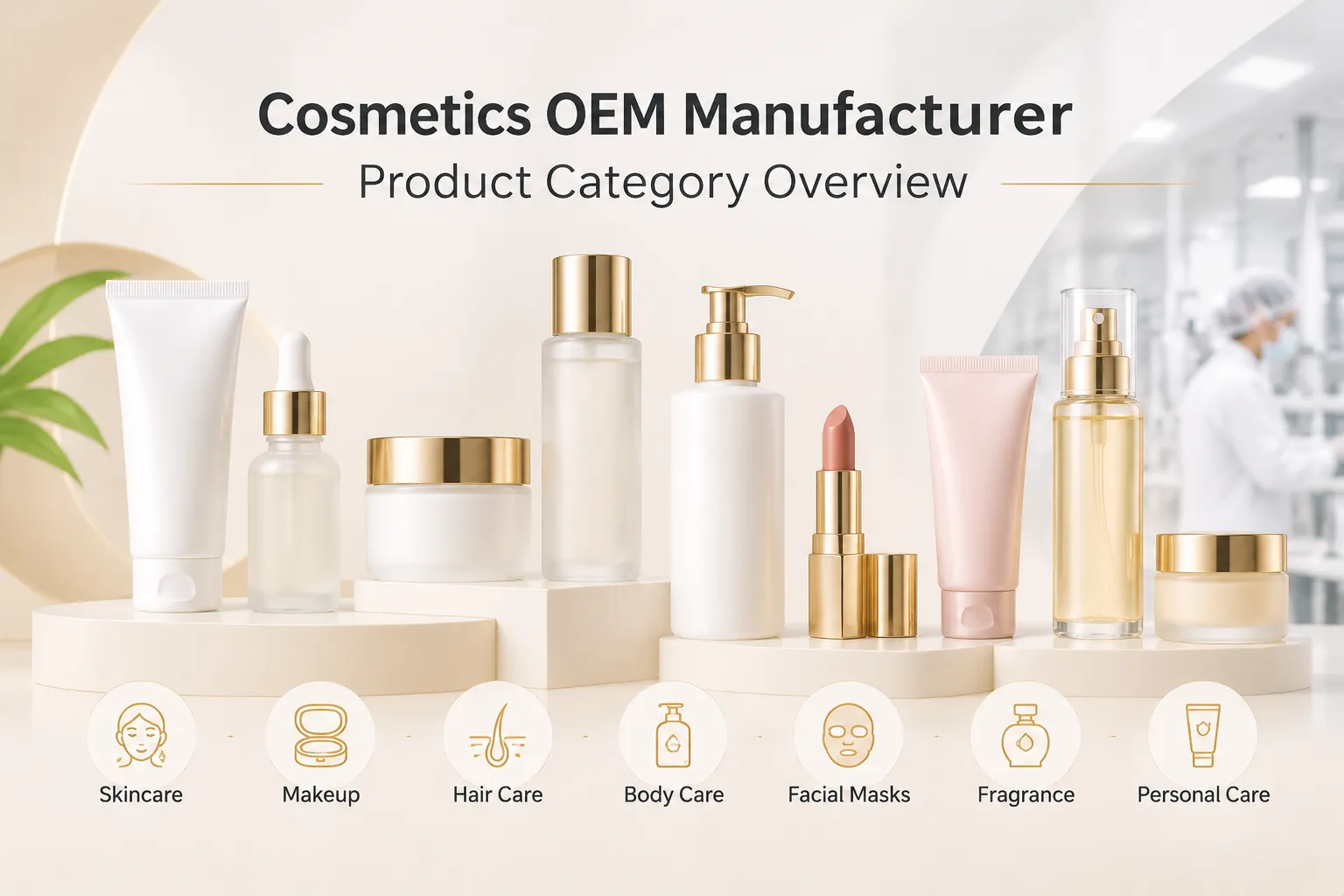
Does the Manufacturer Cover Your Product Categories?
Ask for a full list of product categories the factory actively produces — not categories they claim to handle. Confirm whether skincare, makeup, body care, hair care, and specialty items like facial masks or serums are all made in-house or subcontracted.
Can They Develop Different Formulas and Textures?
Formula variety matters enormously for brand differentiation. A capable manufacturer should be able to develop lightweight serums, rich creams, gel formulas, oil-based products, and rinse-off formats without routing you to a third party.
Do They Support Both Skincare and Makeup Manufacturing?
Skincare and color cosmetics require very different production environments, raw material sourcing, and testing protocols. If your product line crosses both categories, verify that the manufacturer has dedicated facilities for each — not a single production line handling everything.
Here is what to look for in this area:
- A clearly defined product category list with active production lines for each
- In-house capability for different formula types (emulsions, gels, powders, anhydrous products)
- Separate or specialized production environments for color cosmetics vs. skincare
- Willingness to share formula libraries or product showcases from previous development work
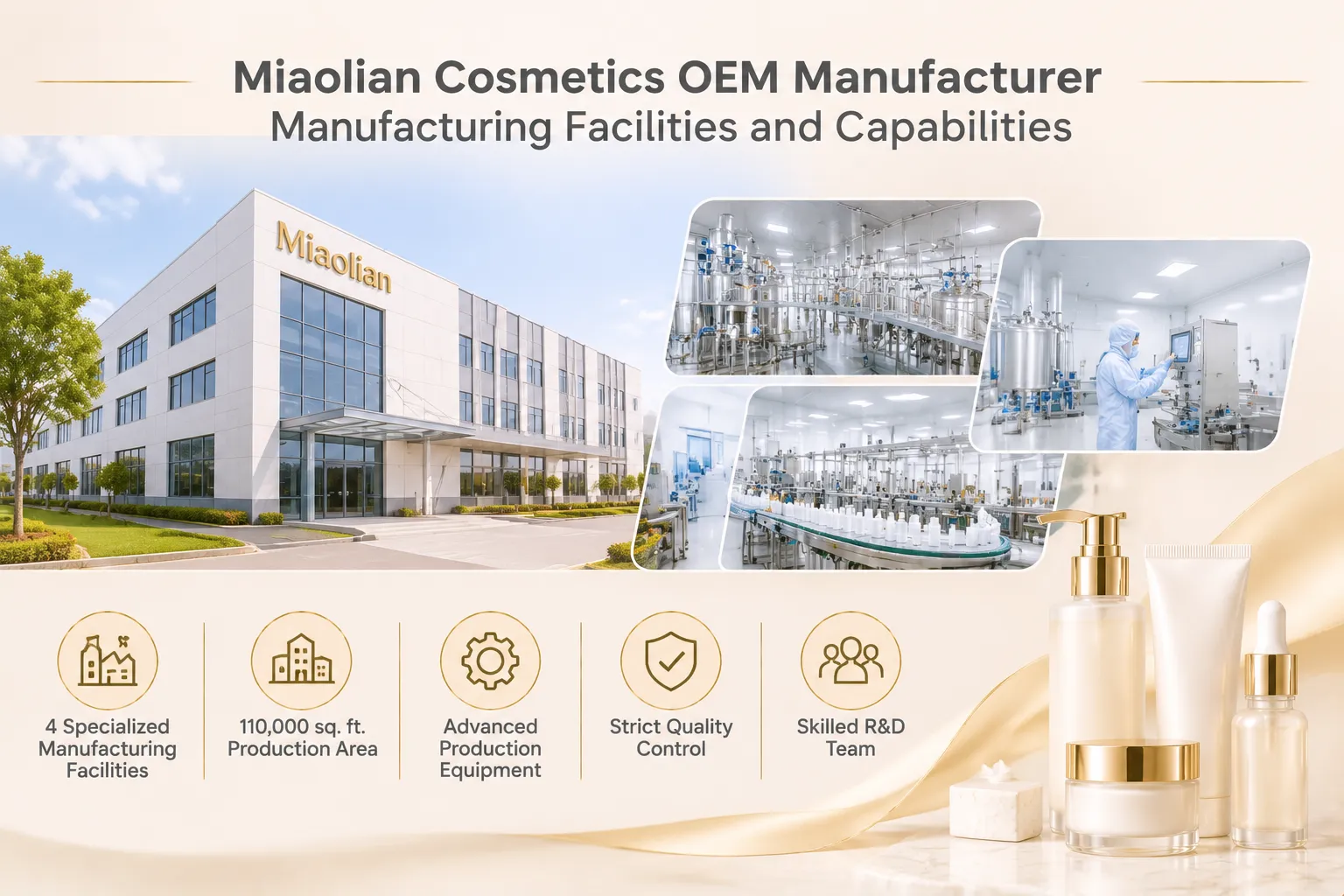
At Miaolian, our four specialized manufacturing bases are dedicated to different product categories — skincare and facial masks, makeup, body care, and hair care are each handled by purpose-built facilities. That separation matters for quality consistency and cross-contamination control.
2. What Are the Manufacturer's OEM and ODM Capabilities?
Many buyers arrive at this question without a clear understanding of what OEM and ODM actually involve. Knowing the difference shapes every downstream decision about formula ownership, development timelines, and cost.
OEM (Original Equipment Manufacturing) means the factory produces products to your specifications — your formula, your brief. ODM (Original Design Manufacturing) means the factory provides existing formulas that you can brand and launch as your own. Both routes have legitimate advantages depending on where you are in your product development journey.
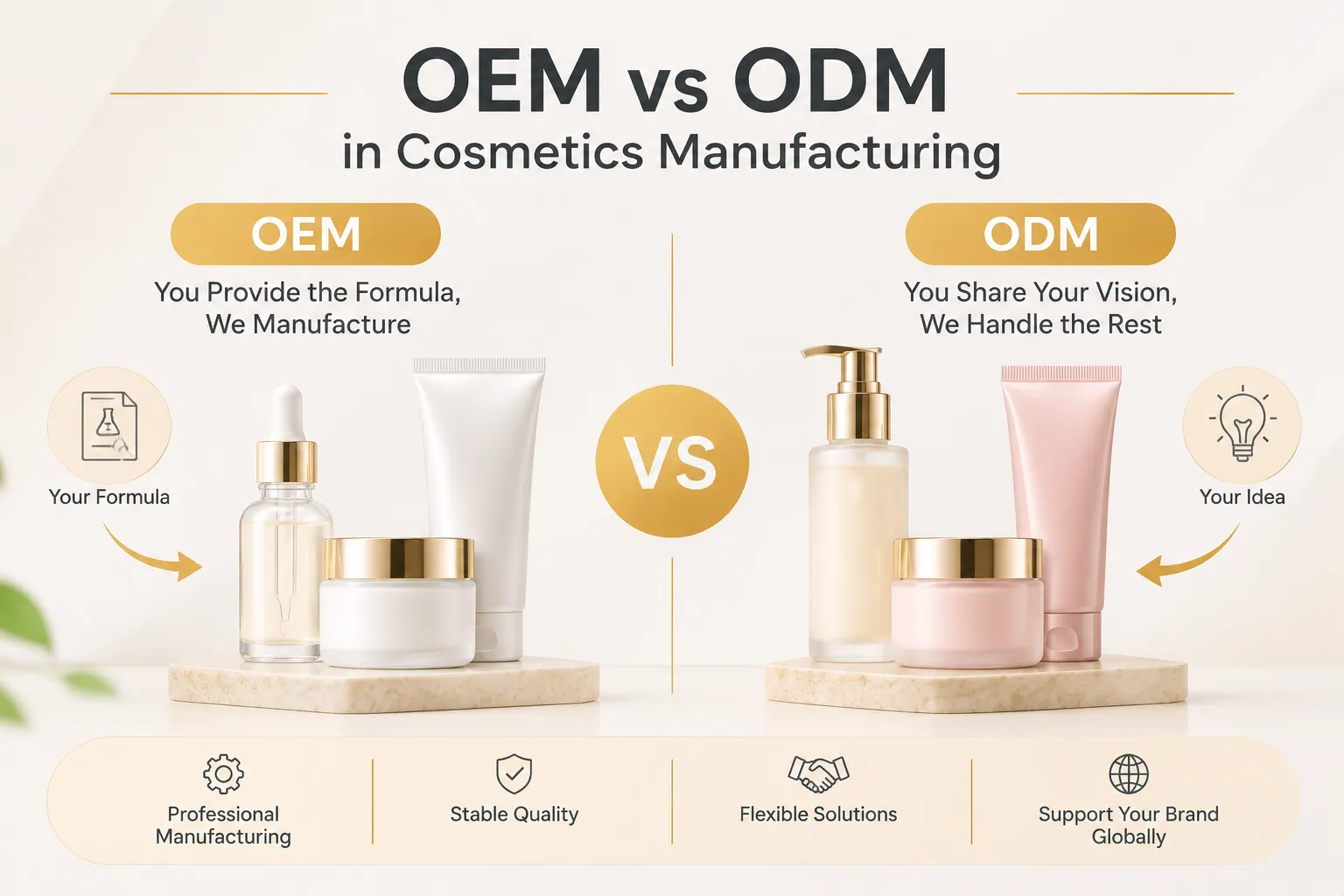
Do They Offer Existing Formulas and Custom Formulation?
A well-resourced manufacturer maintains a library of proven, tested formulas available for ODM launches. For OEM work, they should have the in-house R&D capacity to develop formulas from scratch based on your brief. Ask how many formulas are in their library and how many R&D professionals are on staff.
Can They Customize Ingredients and Product Specifications?
This is where technical flexibility shows. Some factories will adjust fragrance, active ingredient concentration, or texture within predefined limits. Others can reformulate substantially. Understand exactly how deep their customization capability goes before assuming you can achieve your target product concept.
Do They Provide Packaging and Private Label Services?
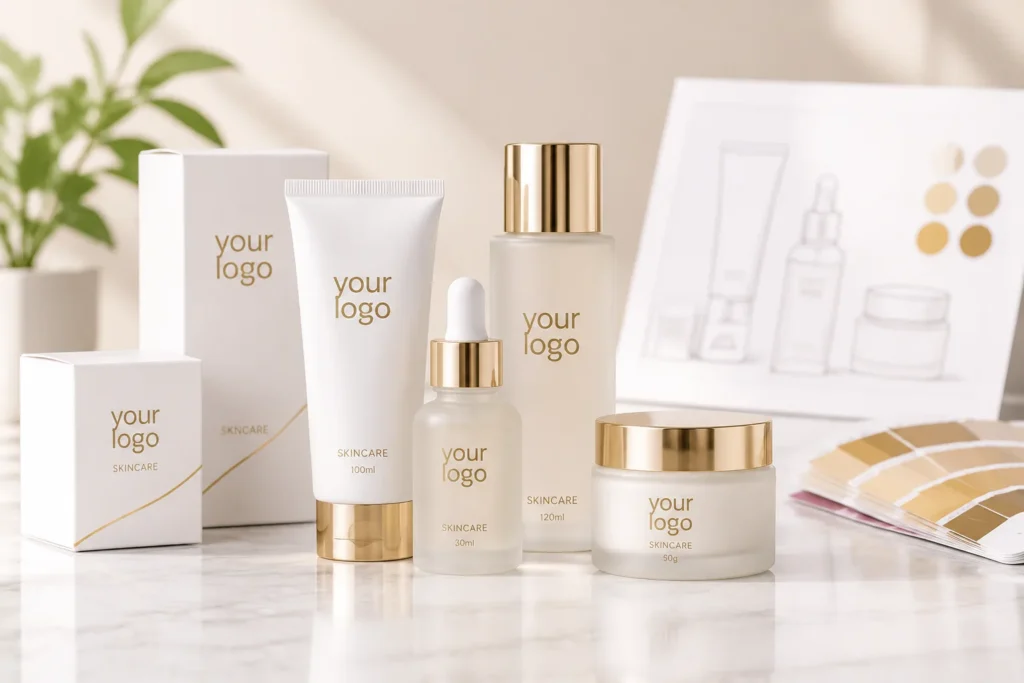
A full-service manufacturer handles more than the product inside the bottle. Ask whether they source and customize packaging, apply private label printing, and manage the complete finished unit — or whether you will be coordinating a separate packaging supplier yourself.
Key capability questions to ask:
- How many R&D professionals does the team include?
- How large is the formula library, and how many are commercially proven?
- Can they modify active ingredient concentrations on request?
- Is packaging sourcing and customization managed in-house?
- Do they have experience developing products for specific market segments (e.g., natural, vegan, clinical)?
Miaolian's R&D team includes 60+ professionals and maintains a library of 4,000+ proven formulas. That depth means we can offer ODM solutions for fast launches and OEM development for brands that want proprietary formulations.
3. What Is the Minimum Order Quantity (MOQ)?
MOQ is often the first number a buyer asks about — but it is rarely the number that matters most on its own. MOQ varies significantly depending on formula complexity, packaging type, and customization requirements.
Understanding MOQ in context prevents situations where a quoted low MOQ turns out to apply only to standard formulas with off-the-shelf packaging, while your customized product requires a much higher commitment.
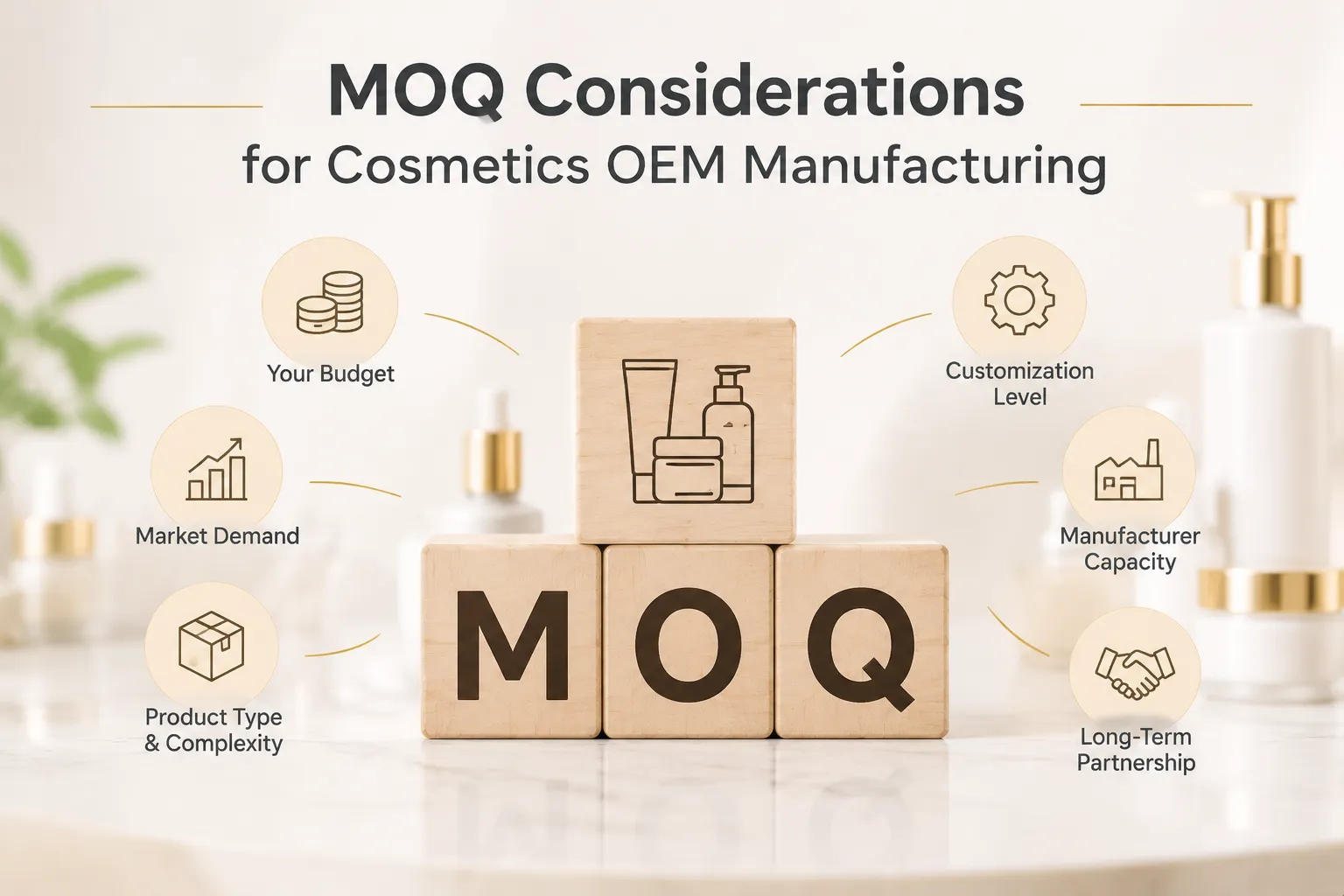
What Is the MOQ for Different Product Categories?
MOQ is not uniform across a product range. A facial sheet mask may have a very different MOQ than a foundation or a hair mask. Request category-specific MOQ information rather than a single blanket figure.
Can MOQ Be Adjusted Based on Packaging and Formula Requirements?
Custom packaging and proprietary formula development often require higher MOQ to justify tooling, development, and material sourcing costs. Ask what drives MOQ and whether flexibility exists as your order volume grows.
Do They Support Small-Batch Production for Startups?
For early-stage brands, small-batch production capability is a significant advantage. It allows you to test a product in-market before committing to large volumes. Confirm whether the manufacturer has infrastructure for smaller runs or whether their minimum thresholds require significant upfront investment.
What to evaluate when discussing MOQ:
| Factor | Why It Affects MOQ |
|---|---|
| Formula type | Standard vs. fully custom formulas have different development cost thresholds |
| Packaging | Custom bottles and jars require tooling investment, raising MOQ |
| Ingredient sourcing | Specialty raw materials may have minimum purchase requirements |
| Production line configuration | Some lines are optimized for large runs, others for shorter runs |
| Label and printing requirements | Custom printing has setup costs that affect minimum viable quantities |
Miaolian offers flexible MOQ options designed to support businesses at different stages — from startups testing a first product to established brands scaling to mass production. Specific MOQ details depend on the formula, packaging, and customization scope, and are confirmed during the initial project discussion.
4. What Certifications and Quality Standards Does the Factory Have?
This is the section that many buyers skip too quickly — particularly when they are focused on price or speed. Certifications are not just documents. They represent the manufacturing environment your product is made in, and by extension, the safety and consistency standards your customers will experience.
I have seen situations where buyers received a list of certification names from a supplier without ever verifying whether those certifications were current, applicable to the product category in question, or audited by a recognized body. Documents should be verified, not taken at face value.
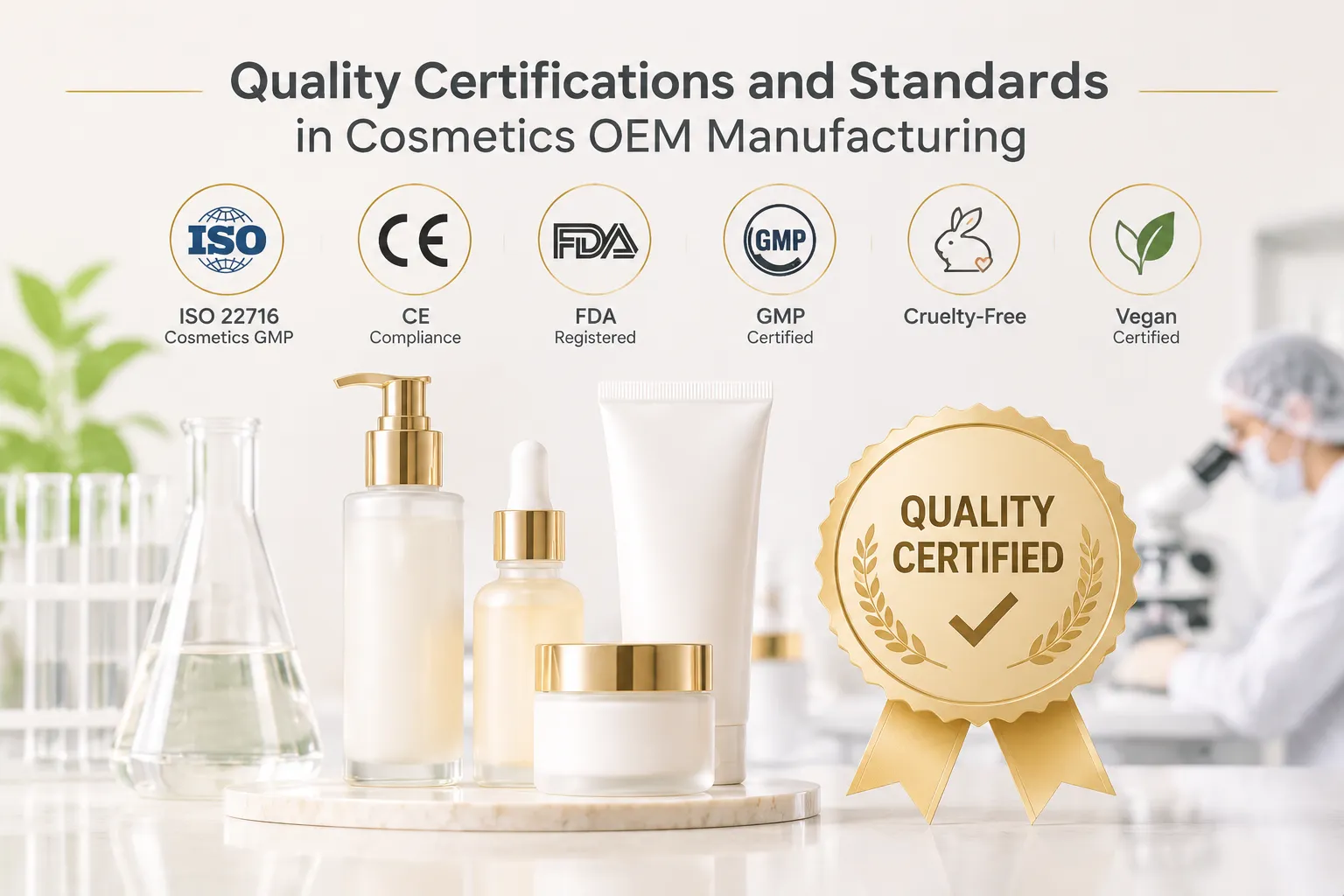
Is the Manufacturer ISO 22716 or GMP Compliant?
ISO 22716 is the internationally recognized standard for cosmetics Good Manufacturing Practices (GMP). It governs production, control, storage, and shipment of cosmetics products. GMPC is the Chinese equivalent and is widely accepted in the industry. Ask for documentation and verify its current status.
What Quality Control Procedures Are in Place?
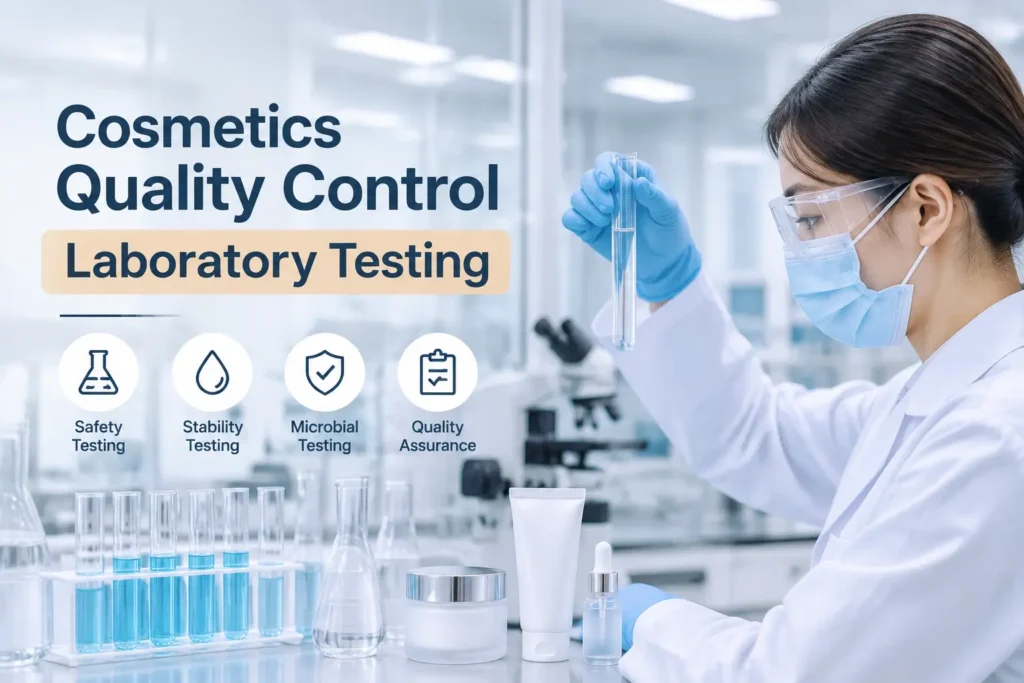
A credible manufacturer implements multi-stage quality control — not just a final inspection before shipping. Ask about incoming raw material inspection, in-process monitoring, semi-finished product testing, and finished product release procedures.
Can They Provide Relevant Manufacturing and Quality Documents?
Documentation you may need includes Certificates of Analysis (COA), Safety Data Sheets (MSDS or SDS), batch manufacturing records, and stability test reports. Confirm which documents the factory routinely provides and which require a specific request.
Do They Support Product Testing and Regulatory Documentation?
Different markets require different compliance documentation. The EU requires a Cosmetics Product Safety Report (CPSR). The US requires FDA registration for certain product types. Ask whether the manufacturer provides regulatory documentation support and what their experience is with your target market.
A practical quality checklist:
- Request copies of active certifications (ISO 22716, GMPC, ISO 9001, etc.)
- Ask whether certifications cover all product categories you plan to source
- Confirm the quality control stages in the manufacturing process
- Verify whether microbiological and stability testing is conducted in-house or through third-party laboratories
- Ask about their process for handling non-conforming product batches
Miaolian's certifications include GMPC, ISO 22716, ISO 9001, ISO 45001, and FDA-related standards as identified in our company documentation. We implement a multi-stage quality control system covering raw material inspection, in-process monitoring, semi-finished product testing, finished product inspection, and final batch release review. Specific certification scope and documentation requirements should always be confirmed for your product and target market.
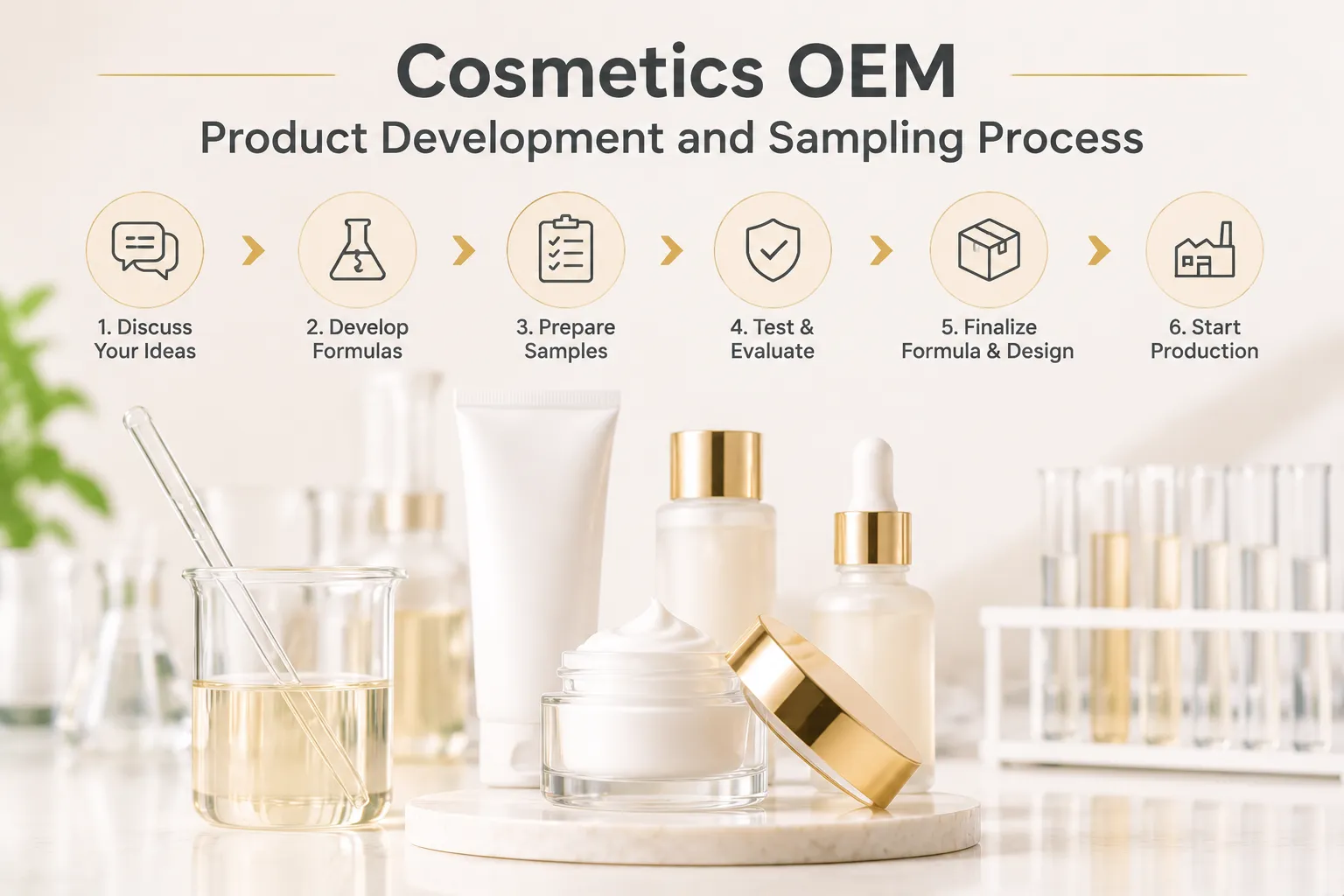
5. What Is the Product Development and Sampling Process?
The sampling process is where you discover whether a manufacturer's capabilities actually match what they have described. It is also where miscommunication about specifications leads to multiple sample revisions, delays, and frustrated timelines.
Understanding the development workflow before it starts prevents the most common friction points. Ask for a process overview in writing if possible.
How Does the Formula Development Process Work?
For ODM orders, the process typically involves selecting from an existing formula library and adjusting fragrance, color, or minor specifications. For OEM custom development, it involves briefing R&D on your concept, reviewing formula options, and approving a development direction before lab samples are prepared.
How Long Does Sample Development Take?
Timeline expectations vary significantly by product complexity. A standard ODM formula modification may take two to four weeks for initial samples. A fully custom formulation with novel ingredients may take considerably longer. Get a realistic estimate in writing, not a best-case scenario.
Can Samples Be Adjusted Based on Feedback?
This is a practical question that reveals a lot about how the manufacturer manages the development relationship. Ask how many rounds of revision are included, whether revisions affect timeline or cost, and who is your point of contact throughout the process.
What Happens Before Mass Production Begins?
A responsible manufacturer requires signed sample approval, confirmed product specifications, and production documentation before moving to mass production. If a factory is willing to proceed to full production without written approval of a final sample, that is a significant red flag.
The standard development stages to confirm:
- Brief submission and product concept review
- Formula development or selection from existing library
- Lab sample preparation
- Sample testing (stability, microbiological, efficacy as required)
- Sample submission and customer review
- Revision rounds based on feedback
- Final sample approval and specification sign-off
- Production documentation preparation
- Mass production authorization
Miaolian's service process moves from product concept through formula development, sampling, testing, mass production, and delivery — with customer approval required at each milestone before the next stage begins.
6. What Is the Production Capacity and Lead Time?
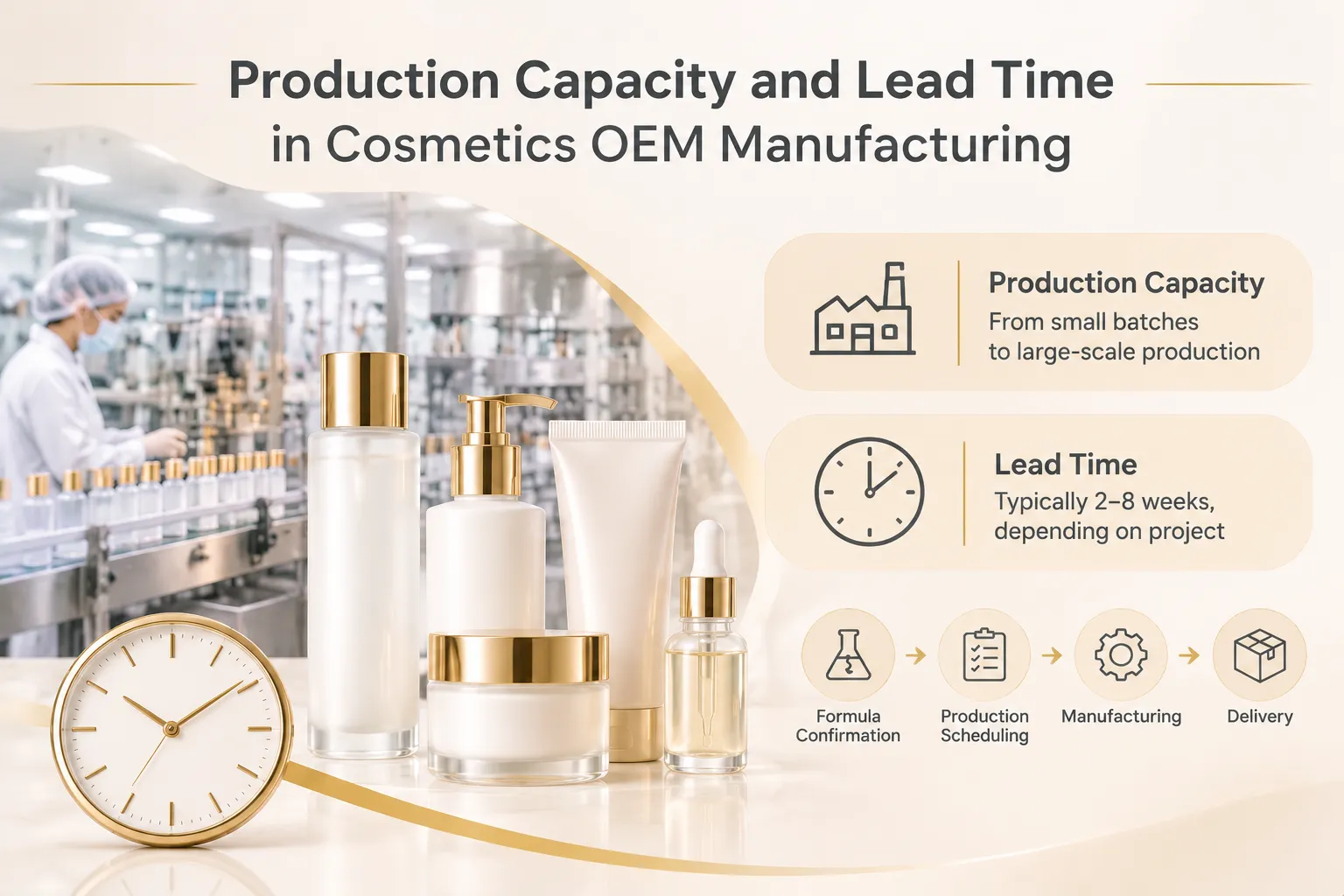
A manufacturer that cannot reliably deliver on time is a liability, regardless of how good their formulas are. Production capacity and lead time questions reveal whether a factory's infrastructure matches your business requirements — now and as you scale.
The question is not just "can they make it?" but "can they make it consistently, at your required volume, within your timeline?"
How Many Products Can the Factory Manufacture?
Ask about daily or monthly production output for the specific product categories you are sourcing. Understand how many production lines are dedicated to your product type and what the realistic capacity ceiling is.
What Is the Typical Production Lead Time?
Lead time typically covers raw material sourcing, production scheduling, manufacturing, quality inspection, and final packaging. Ask for a breakdown of lead time by stage rather than a single total figure. This helps you identify where delays are most likely to occur.
Can They Handle Large or Repeat Orders?
For distributors and wholesalers with recurring order needs, production stability is as important as capacity. Ask how the factory manages repeat orders, whether you can secure a production slot in advance, and what happens during peak periods.
How Do They Manage Production Schedules?
A well-organized manufacturer uses production scheduling systems to manage lead times, raw material procurement, and line allocation. Ask whether they communicate proactively about production status and whether you receive updates at key production milestones.
Capacity and timeline factors to compare:
| Consideration | Questions to Ask |
|---|---|
| Production lines | How many lines are dedicated to your product category? |
| Daily output | What is the realistic daily fill capacity? |
| Lead time breakdown | How is lead time divided between sourcing, production, and QC? |
| Peak season management | How do they handle demand spikes in Q4 or other peak periods? |
| Communication cadence | How often will you receive production updates? |
| Contingency planning | What happens if raw material delays occur? |
Miaolian operates 12 production lines with an emulsification capacity of up to 180 tonnes per day and a filling capacity of up to 10,000 bottles per day, as stated in our facility specifications. We work with clients to align production scheduling to their delivery requirements.
7. How Does the Manufacturer Handle Packaging and Customization?
Packaging is not an afterthought. It is part of your brand identity, your shelf presence, and your customer's first physical experience with your product. A manufacturer that handles packaging in-house — or through a tightly managed supply chain — gives you more control and fewer coordination headaches.
The alternative is managing a separate packaging supplier yourself, which introduces its own quality, timeline, and cost risks.
What Packaging Options Are Available?
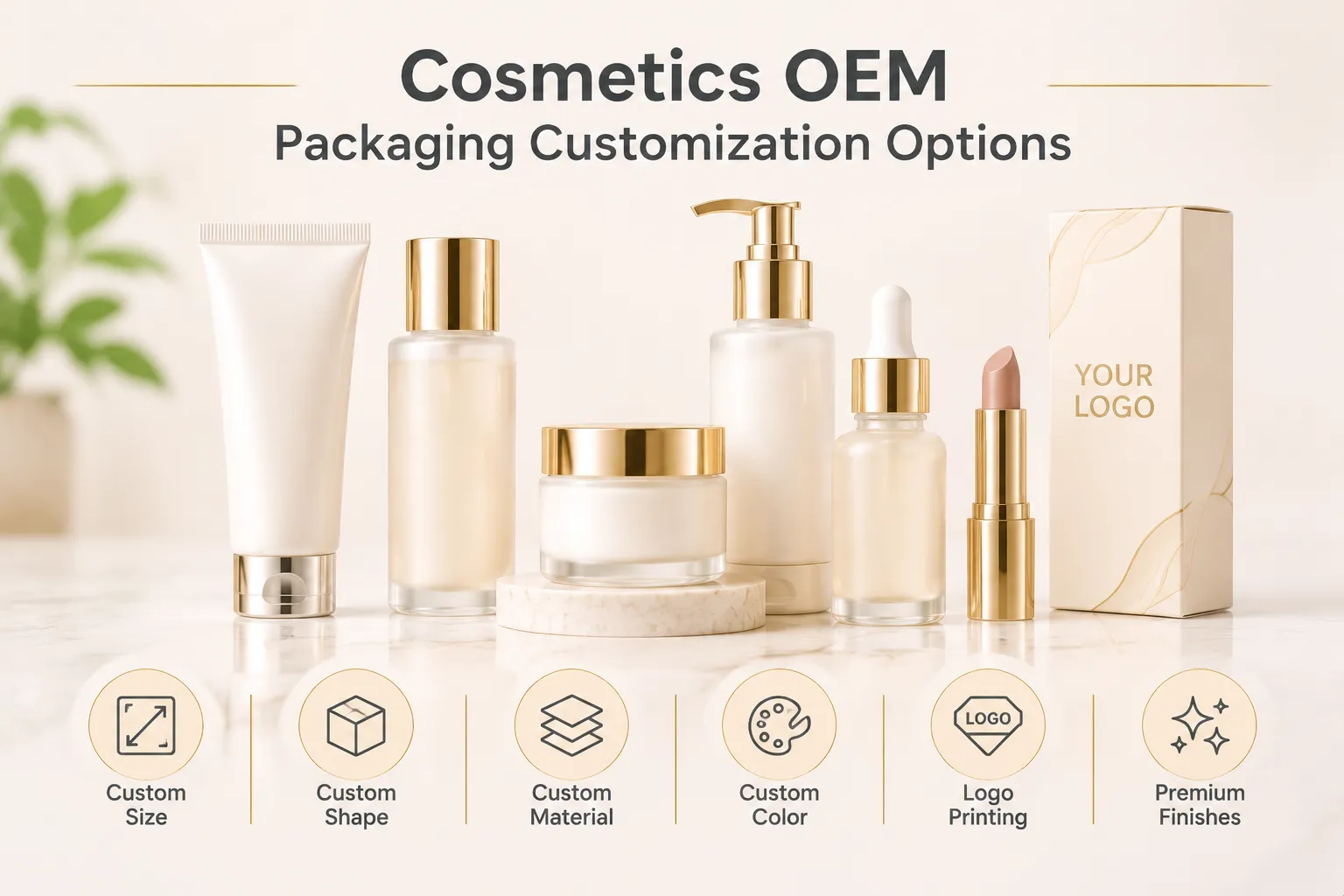
Ask for a packaging portfolio covering bottles, tubes, jars, pumps, droppers, and other closure types. Understand whether these are standard options available off-the-shelf or whether custom tooling is required for different shapes and sizes.
Can They Source Custom Bottles, Jars, and Containers?
If you require packaging that reflects your brand aesthetic — a specific bottle shape, a particular material, or a distinctive color — ask whether the manufacturer can source or develop custom packaging and what the lead time and minimum order implications are.
Do They Support Custom Labels, Logos, and Product Design?
Label printing, logo application, and gift set assembly should all be capabilities you confirm. Ask what printing methods are available, what file formats they accept for artwork, and how they manage label quality control.
Packaging evaluation checklist:
- Full range of packaging types (bottles, tubes, jars, pumps, droppers, sachets)
- Availability of standard vs. custom packaging options
- Minimum order quantities for custom packaging
- Packaging compatibility testing with your formula
- Label printing methods and artwork specification requirements
- Carton and gift set assembly capability
- Lead time for custom packaging vs. standard packaging
Miaolian provides comprehensive packaging customization through an integrated packaging supply chain covering bottles, tubes, jars, pumps, droppers, labels, folding cartons, and gift sets. This in-house capability helps reduce sourcing complexity and supports faster delivery.
8. What Are the Pricing, Payment Terms, and Additional Costs?
Pricing conversations reveal a great deal about a manufacturer's transparency — or lack of it. A quote that looks significantly cheaper than alternatives should prompt questions, not celebration. The goal is to understand what is included, what is not, and what factors will affect your final cost.
Experienced buyers know that unexpected additional charges — for formula development, tooling, testing, or regulatory documentation — can materially change the economics of a sourcing relationship.
What Factors Affect OEM Cosmetics Manufacturing Costs?
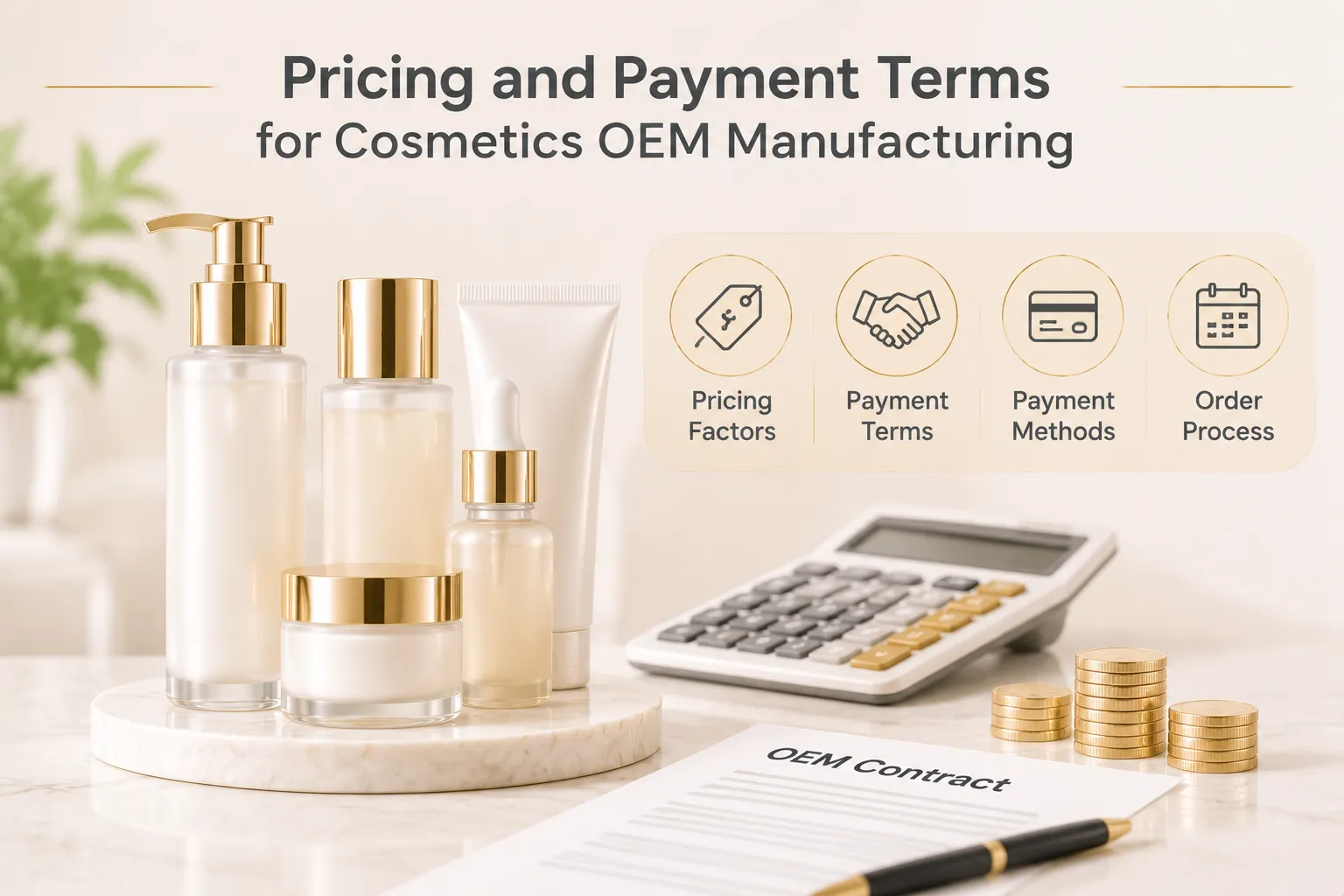
Manufacturing cost is shaped by formula complexity, raw material specifications, packaging type, order volume, and customization depth. A fragrance-free, single-active basic moisturizer will cost very differently from a multi-peptide serum in custom glass packaging.
Are There Additional Fees for Formula Development and Packaging?
Some manufacturers charge separately for R&D time, formula development, tooling for custom packaging, and regulatory documentation. Others include these costs in the unit price at sufficient volume. Clarify the full cost structure before comparing quotes.
What Are the Payment Terms?
Standard payment terms in cosmetics OEM manufacturing typically involve a deposit before production begins and a balance payment before shipment. Ask about deposit percentages, accepted payment methods, and whether letter of credit arrangements are available for large orders.
How Does Order Quantity Affect Unit Pricing?
Volume discounts are standard, but the relationship between quantity and unit cost varies by manufacturer and product. Ask for tiered pricing across different order volumes so you can plan your purchasing strategy accordingly.
Cost factors to clarify in every quotation:
- Base unit manufacturing cost
- Formula development or R&D fee (if applicable)
- Tooling or mold costs for custom packaging
- Sample fees and whether they are credited against future orders
- Testing fees (stability, microbiological, efficacy)
- Regulatory documentation fees
- Minimum packaging order requirements
- Freight and export charges
9. Can the Manufacturer Support International Markets?
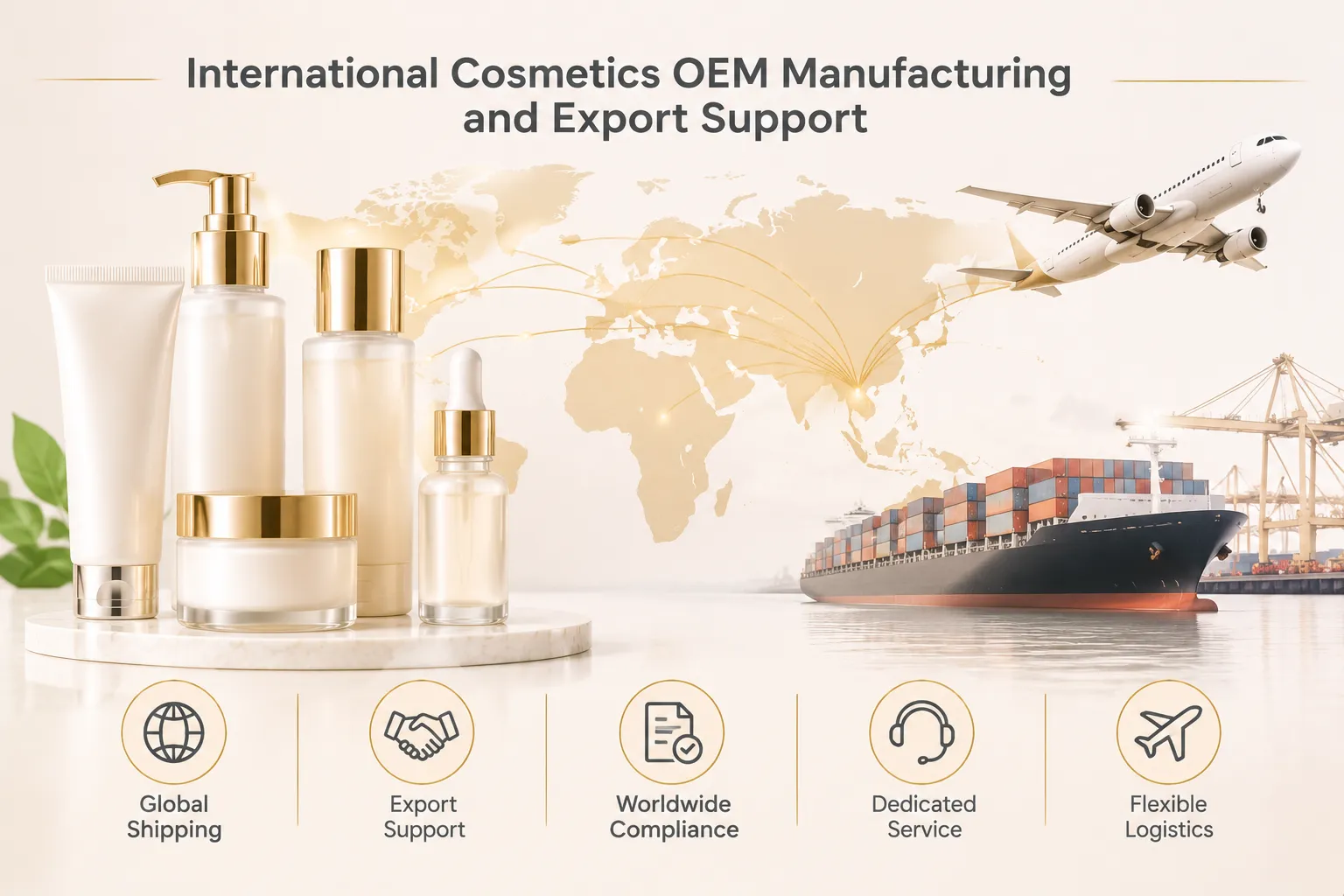
If you are sourcing cosmetics for markets outside China, the manufacturer's experience with international compliance, export documentation, and cross-border logistics is directly relevant to your ability to sell legally and efficiently in your target market.
This is an area where gaps in manufacturer experience create real problems — not during production, but at customs clearance or at the point of regulatory review in your destination market.
Do They Have Experience Working with Overseas Clients?
A manufacturer with a track record of serving international clients has already worked through the common challenges: language barriers, time zone coordination, international payment processes, and cross-cultural expectation management. Ask how many markets they currently export to.
Can They Support Different Market Compliance Requirements?
Different markets have different registration requirements, ingredient restrictions, and labeling rules. The EU, US, Australia, Southeast Asia, and the Middle East each have distinct frameworks. Ask whether the manufacturer has experience providing documentation support for your specific market.
Do They Have Experience with Export Documentation and Shipping?
Export documentation for cosmetics typically includes commercial invoices, packing lists, certificates of origin, certificates of analysis, MSDS sheets, and sometimes country-specific certifications. Ask what documents the manufacturer routinely prepares and what requires additional arrangement.
International market support questions:
- How many countries do they currently export to?
- Do they have experience with EU CPSR support?
- Can they provide FDA-related documentation for the US market?
- Do they work with freight forwarders or leave shipping coordination to the buyer?
- What is their process for handling import compliance queries from foreign customs authorities?
Miaolian currently exports to 70+ markets worldwide. We provide relevant product documentation and regulatory support to help customers prepare for different international market requirements. Specific documentation and regulatory scope should be confirmed for your product and destination market.
10. How Does the Manufacturer Protect Your Brand and Formula?
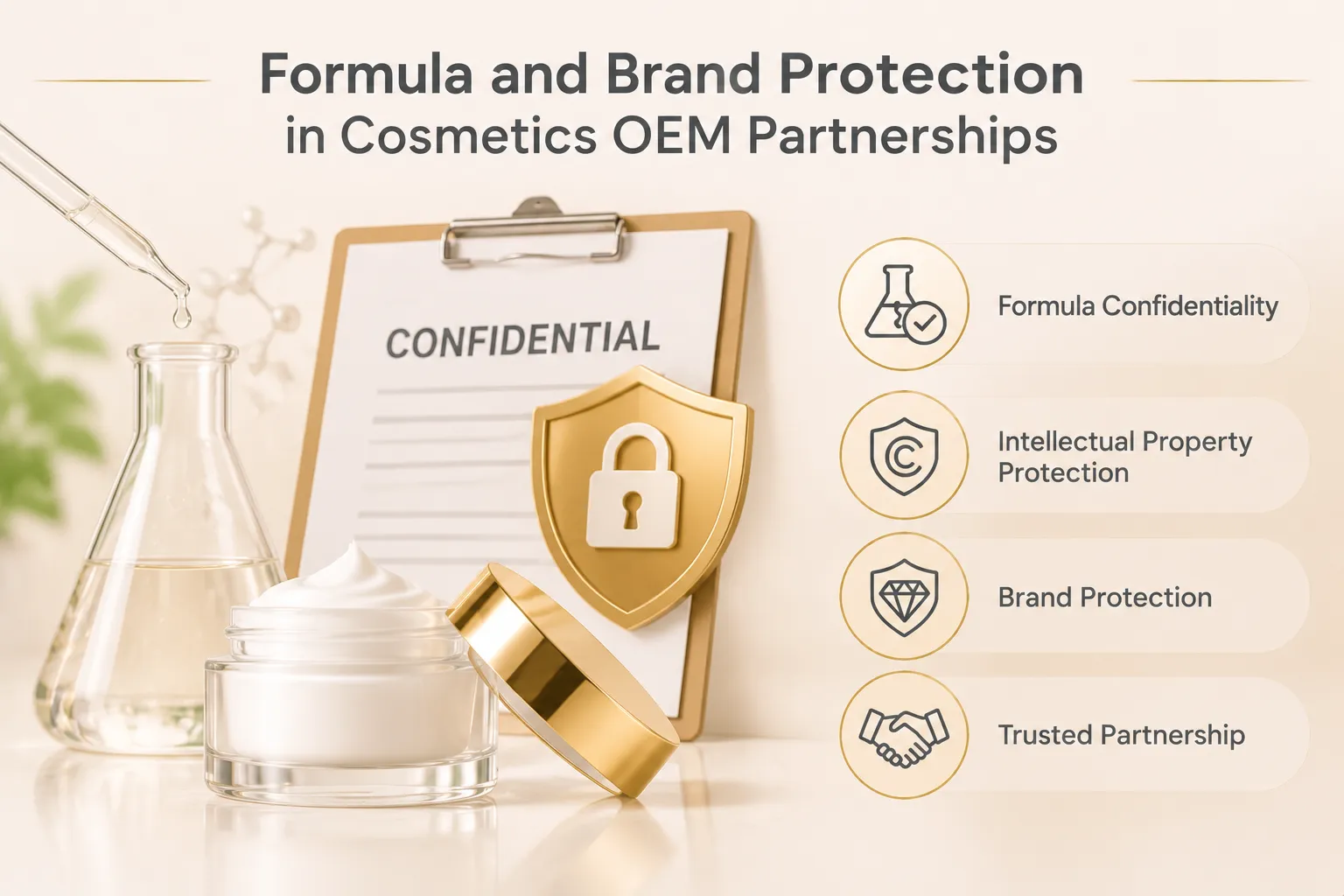
Intellectual property protection is a concern that is often raised late in the conversation — after formulas have already been shared. It should be one of the first things you establish.
A manufacturer that handles dozens of brand clients simultaneously needs clear internal processes for protecting each client's proprietary information. Without these processes, your formula or brand concept could inadvertently inform a competitor's product.
Who Owns the Custom-Developed Formula?
This should be explicitly stated in your manufacturing agreement. For custom-developed formulas, ownership typically transfers to the client upon full payment. For ODM formulas selected from the manufacturer's library, usage rights may be non-exclusive unless specifically negotiated.
Can They Sign a Non-Disclosure Agreement (NDA)?
A manufacturer willing to sign a comprehensive NDA demonstrates a mature approach to client relationships. The NDA should cover formula specifications, product development briefs, packaging designs, brand materials, and any business information shared during the engagement.
How Is Customer and Product Information Protected?
Ask about internal data handling procedures. Who has access to your formula documentation? How are product specifications stored and shared internally? What happens to your data if the relationship ends?
IP protection checklist:
- Confirm formula ownership terms before development begins
- Review what constitutes "confidential information" in the NDA
- Ensure the NDA covers employees and subcontractors, not just the company
- Clarify data retention and deletion policies
- Understand the dispute resolution process if IP issues arise
11. What Should You Look for Before Signing an OEM Manufacturing Agreement?
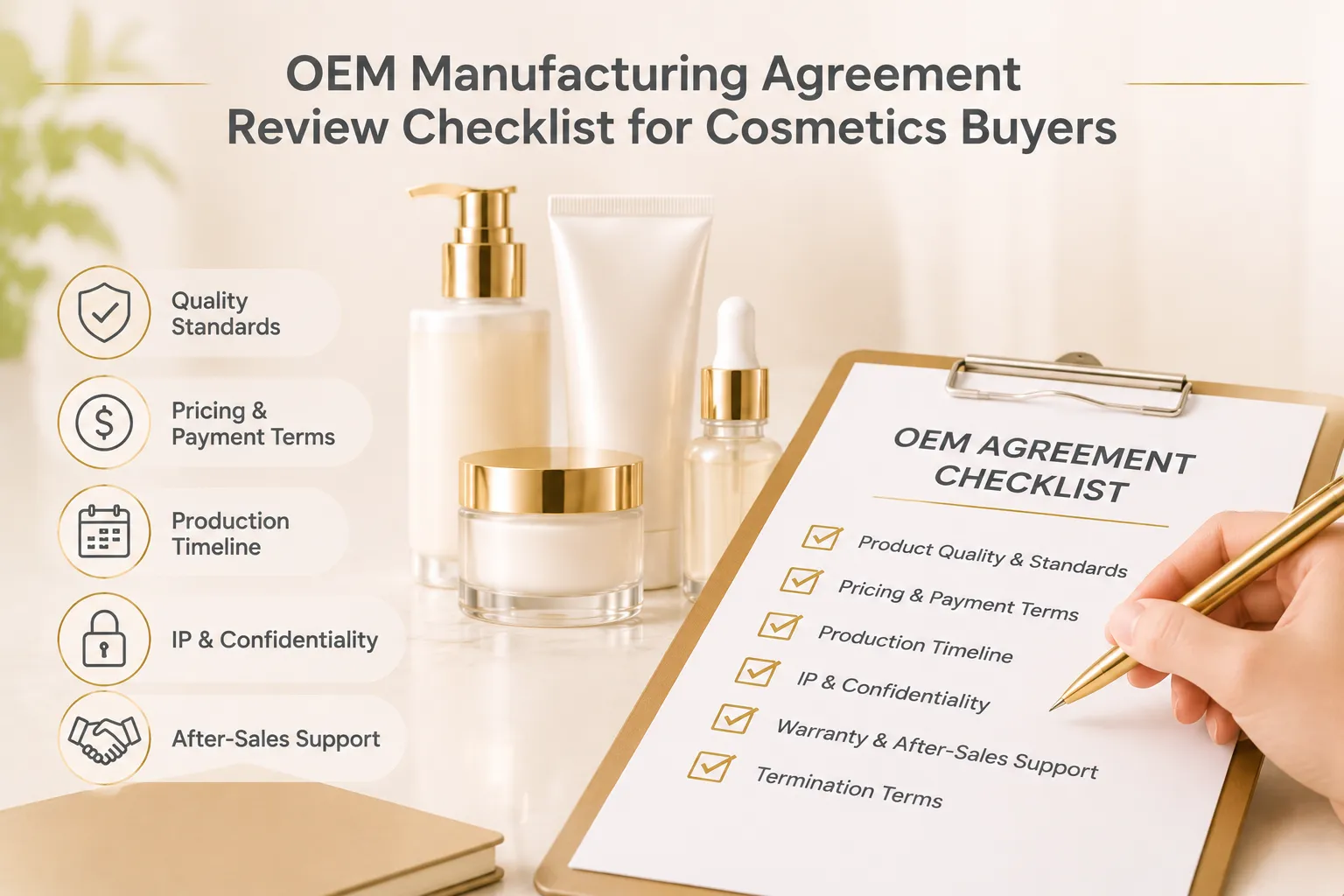
The manufacturing agreement is where every verbal assurance becomes — or fails to become — a binding commitment. A well-structured contract protects both parties and creates a clear operational framework for the entire manufacturing relationship.
Reviewing a contract carefully before signing is not a sign of distrust. It is standard professional practice, and a manufacturer that discourages careful review is a manufacturer worth reconsidering.
Are Product Specifications and Quality Standards Clearly Defined?
The contract should reference specific, agreed product specifications — formula version, packaging specifications, fill weight, color, fragrance, texture, pH range, and any other measurable parameters. Vague specifications create disputes during quality inspection.
Are Production Timelines and Delivery Terms Confirmed?
Production start dates, expected completion dates, and delivery terms (FOB, CIF, EXW, etc.) should all be clearly stated. Include provisions for what happens if timelines are not met and who bears the cost of delays caused by each party.
Are Payment, Warranty, and Dispute Terms Clearly Stated?
Payment milestones, accepted currencies, warranty coverage for non-conforming goods, and the process for raising and resolving quality disputes should all be explicitly addressed. Ambiguity in these areas creates problems that are difficult and expensive to resolve.
Pre-signing review checklist:
- Product specifications referenced clearly and completely
- Quality standards and inspection criteria defined
- Production timeline and delivery milestones stated
- Payment schedule, methods, and conditions confirmed
- IP and formula ownership terms explicit
- NDA provisions included or attached
- Warranty terms and defective product process defined
- Dispute resolution process specified (jurisdiction, mediation, arbitration)
- Change order process described for mid-production specification changes
Why Choose Miaolian as Your Cosmetics OEM Manufacturer?
The questions in this guide are designed to help you evaluate any manufacturing partner objectively. When buyers ask us these same questions, here is what we tell them.
Four Specialized Manufacturing Facilities
Miaolian operates four dedicated manufacturing bases covering skincare, facial masks, makeup and color cosmetics, body care, and hair care. Each facility is purpose-built for its product category, maintaining appropriate production environments, equipment, and quality protocols for each product type.
Comprehensive OEM and ODM Product Solutions
We support OEM manufacturing from customer-provided formulas and ODM product development from our library of 4,000+ proven formulas. Our offering covers skincare, facial masks, body care, hair care, makeup, soap, fragrance, and home care — giving brand owners and distributors access to multi-category product development through one manufacturing partner.
Professional Product Development and Customization
Our R&D team of 60+ professionals works with customers to develop formulas that match their brand concept, target market, and ingredient preferences. We support everything from minor ODM formula adjustments to fully custom formulation projects, with a 500㎡ dedicated R&D center and established relationships with international raw material suppliers.
Integrated Manufacturing and Quality Management
Miaolian implements a multi-stage quality control system covering incoming raw material inspection, in-process monitoring, semi-finished product testing, finished product inspection, and final batch release review. Our facilities operate under GMP-standardized environments with Class 100,000 clean filling workshops.
Support for Global Beauty Brands and Business Partners
With 25+ years of manufacturing experience since 1999, 1,800+ employees, and an active export presence across 70+ markets, Miaolian is structured to support global beauty businesses at every stage — from first-time brand launches to established brands scaling their supply chain. We provide documentation and regulatory support to help customers prepare for their target markets.
Frequently Asked Questions (FAQs)
How Do I Choose a Reliable Cosmetics OEM Manufacturer?
Evaluate a manufacturer's production capabilities, certifications, R&D depth, quality control procedures, and international track record. Request samples, verify certifications directly, and ask for client references when possible. A reliable cosmetics OEM manufacturer will answer detailed questions confidently and provide documentation to support their claims.
What Is the Difference Between OEM and ODM Cosmetics Manufacturing?
OEM manufacturing produces products to your existing formula and specifications. ODM manufacturing provides existing formulas that you brand and launch as your own products. OEM suits brands with proprietary formulations; ODM suits brands that want faster time-to-market using proven, tested product bases.
What Is the Typical MOQ for Cosmetics OEM Manufacturing?
MOQ varies significantly by product category, formula type, and packaging requirements. Standard ODM products with off-the-shelf packaging typically carry lower MOQs than fully custom OEM products. Discuss your specific product requirements directly with the manufacturer to get accurate MOQ figures.
How Long Does OEM Cosmetics Production Take?
Total production time depends on formula development complexity, packaging sourcing, production scheduling, and quality testing. For ODM products with standard packaging, timelines can be as short as four to six weeks after sample approval. Custom OEM projects with new formulas and bespoke packaging require longer development and production timelines.
Can a Cosmetics OEM Manufacturer Help Develop Custom Formulas?
Yes, manufacturers with in-house R&D teams can develop custom formulas based on your product concept, ingredient preferences, and target market requirements. Confirm the R&D team's size, the formula library depth, and the development process before committing to a custom development project.
What Certifications Should a Cosmetics Manufacturer Have?
ISO 22716 (Cosmetics GMP) and GMPC are the most widely recognized quality standards for cosmetics manufacturing. Additional certifications such as ISO 9001, ISO 45001, and FDA-related standards may also be relevant depending on your target market. Always verify that certifications are current and applicable to your specific product categories.
Can I Visit a Cosmetics OEM Factory Before Placing an Order?
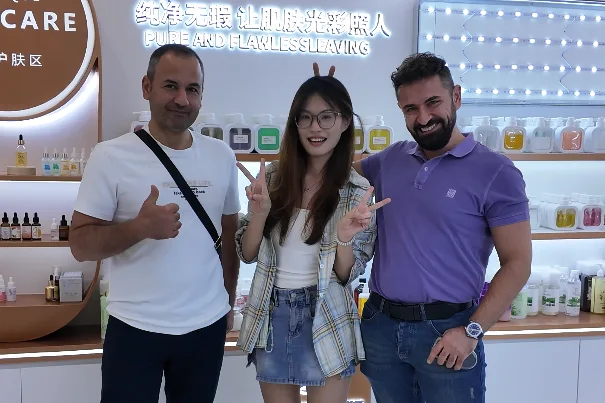
Factory visits are strongly recommended for significant supply chain commitments. An in-person visit lets you assess the manufacturing environment, meet the R&D and quality teams, and verify that the facility matches what has been presented. Many manufacturers also offer virtual factory tours as an alternative for international buyers unable to travel.
What Information Should I Prepare Before Contacting a Cosmetics OEM Manufacturer?
Prepare a product brief covering your target product category, desired formula type and texture, key ingredients or functional claims, packaging preferences, target market, estimated order volume, and timeline. The more specific your brief, the more accurate the manufacturer's initial response will be.
Conclusion: Choose the Right Cosmetics OEM Manufacturer for Long-Term Growth
Selecting a cosmetics OEM manufacturer is a strategic business decision, not just a purchasing transaction. The questions in this guide cover product capabilities, R&D depth, quality certifications, MOQ flexibility, pricing transparency, international compliance support, and intellectual property protection — the factors that determine whether a manufacturing relationship succeeds or fails over time. Take each section seriously, verify claims with documentation, and test before you commit at scale. If you are evaluating manufacturing partners for your beauty brand or distribution business, we welcome your questions. Contact Miaolian to discuss your product requirements and find out how our OEM and ODM manufacturing solutions can support your business goals.
<!--[googlesitekit-end-of-content]-->